Where are competitors clustered? Which neighborhoods are underserved? Is this market saturated or wide open? Those are the questions that drive smart location decisions, and they require more than a pin on a map.
Most businesses still make location decisions with incomplete information. They check foot traffic counts, browse Google Maps, maybe bring in a consultant. But they rarely get a clear, full picture of the competitive landscape before signing a lease. That’s a costly gap, and it’s exactly why competitor analysis tools for location-based businesses have become essential. The location intelligence market is growing at 16.8% annually (a compound annual growth rate) per Grand View Research, 2025-2030, because operators are finally getting the tools to close it.
Market Insight
“The global location intelligence market is projected to reach $53.6B by 2030 at a 16.8% CAGR.”
Why Location Intelligence Tools Matter for Competitor Research

The location intelligence market is on track to more than quadruple in a decade, from $21.2B in 2024 to over $104B by 2034 (Global Growth Insights). That growth isn’t driven by large enterprises buying more software. It’s driven by operators at every level finally getting access to competitor analysis tools that used to require specialized mapping expertise and a six-figure budget.
Location Intelligence Market Growth (USD Billions)
2024
$21.2B
2026
$29.4B
2028
$42.0B
2030
$53.6B
2034
$104.1B
Source:
Global Growth Insights
The stakes behind that growth are concrete. Location is one of the most cited factors in business failure, particularly in food and retail. A bad site selection decision doesn’t just cost you rent. It costs you the entire investment.
“Nearly 40,000 jobs and $3.2B in capital are lost annually to failed restaurants.”
Restaurant failure rates hover around 17% in the first year. Most of those failures aren’t about the food. They’re about opening in the wrong place. Too much competition, not enough foot traffic, a market that was already saturated before the doors opened (Maptive).
The businesses that get location right aren’t luckier. They have better information. That’s what competitor analysis tools for location-based businesses are built to provide.
5 Competitor Analysis Tools for Location-Based Businesses
1. MapQuery.ai: Best for Small Businesses, Franchises, and Real Estate Brokers
MapQuery.ai is an AI-powered location intelligence platform built around natural language POI search. Type “coffee shops” and get competitor pins on an interactive map in real time in your current map view. Click any pin for an AI-generated research report covering business details, reviews, and competitive context.
Best for
Small businesses, franchise owners, and real estate brokers
Pricing
Free tier available (10 searches/day)
Where it stands out is accessibility. No technical mapping knowledge required, and the free tier is genuinely usable. The tradeoff is that it’s lighter on raw data depth than enterprise tools like ArcGIS or Placer. It’s designed for operators who need fast, readable intelligence, not analysts who need to run complex spatial queries.
Built by Geoasset LLC | mapquery.ai
2. Placer.ai: Best for Foot Traffic Analysis
Placer.ai is the gold standard for foot traffic analytics. If you need to know how many people walk past a specific location on a Tuesday afternoon versus a Saturday morning, Placer has the data.
Best for
Retail and QSR operators needing traffic volume data
Pricing
Enterprise (custom quote)
The limitation: Placer is strong on traffic counts and weaker on competitive gap identification. It tells you how busy a location is, but it doesn’t help you understand the competitive landscape around it or generate AI-powered research on individual competitors. And the enterprise pricing puts it out of reach for most independent operators.
3. Esri / ArcGIS Business Analyst: Best for Enterprise Mapping Teams
If you have a dedicated mapping analyst on staff and a budget to match, ArcGIS Business Analyst is the most powerful tool in this list. It’s used by Fortune 500 companies and government agencies for a reason.
Best for
Large enterprise teams with dedicated mapping and data staff
Pricing
~$2,500/yr and up
The limitation: steep learning curve, expensive licensing, and genuinely overkill for small businesses and independent operators. If you don’t have someone who knows what a shapefile is, this tool will frustrate you.
4. SiteZeus: Best for Multi-Unit Franchise Systems
SiteZeus is AI-driven site selection software built specifically for franchise and retail chains. It’s designed for real estate teams evaluating dozens of candidate sites per quarter, not individual operators doing one-off research.
Best for
Multi-unit franchise systems with real estate teams
Pricing
Enterprise (custom quote)
The limitation: SiteZeus is built for franchise systems, not general-purpose competitor research. If you’re a solo operator or a small team, the tool is more than you need and the pricing reflects that.
5. Google Maps + Manual Research: Best for One-Off Free Lookups
Free. Familiar. Widely used. And genuinely useful for a quick sanity check. Google Maps is the starting point most people default to before realizing they need more.
Best for
One-off lookups when you just need to see what’s nearby
Pricing
Free
The limitation: Google Maps is a map, not an intelligence tool. There’s no analysis layer, no AI research, no gap detection, no saved projects, and no way to export or share your findings. It’s great for “is there a Starbucks nearby?” and not much else when you’re making a serious location decision.
How to Choose the Right Competitor Analysis Tool

It depends on what question you’re actually trying to answer. The right competitor analysis tools vary significantly based on your business type, budget, and technical capacity.
Need foot traffic volume for a specific address? Placer.ai is purpose-built for that. Have a dedicated mapping team and an enterprise budget? ArcGIS gives you the deepest analytical toolkit available. Just need a quick sanity check? Google Maps is free and gets the job done.
But there’s a large middle ground that none of those tools serve well: small business owners, independent operators, franchise owners, and real estate brokers who need real competitive intelligence without a technical background or a $10k/year contract.
That’s the gap MapQuery.ai is built for. It’s one of the few competitor analysis tools designed specifically for operators who need real intelligence without the enterprise overhead.
Business Type | Best Fit | Why |
|---|---|---|
Small business / independent operator (retail, food, services) | MapQuery.ai | Affordable, fast, no contract. Good for one location or ten. |
Enterprise with dedicated mapping team | ArcGIS | Maximum analytical depth if you have the staff and budget |
Traffic-first retail analysis | Placer.ai | Best-in-class foot traffic data for high-volume site decisions |
Multi-unit franchise systems | SiteZeus | AI-driven site selection built for franchise real estate teams evaluating multiple sites |
| One-off free lookup | Google Maps | Fine for a quick check, not built for ongoing research |

Real-World Use Cases
Here’s how different operators use competitor analysis tools to make better location decisions:
Franchise Owner Evaluating a Second Location
Search for existing franchises of the same brand plus direct competitors in the target city. A good competitor analysis tool surfaces the competitive density visually. You can see in minutes whether a market is saturated or has room. What used to require a consultant and a week of research can now be done in an afternoon with the right tool.
Cafe Operator Expanding to a Second Location
Map all coffee shops and cafes in the target neighborhood. Identify blocks with low competitor density. If you also have foot traffic data (Placer.ai is useful here), you can cross-reference demand against competition to find the sweet spot. Enough customers, not already saturated.
Real Estate Broker Pitching a Retail Tenant
Pull POI data for the trade area and show the client what’s already there and what’s missing. A map-based competitive analysis is a much stronger pitch than a spreadsheet. It makes the opportunity visible. Competitor analysis tools like MapQuery.ai or ArcGIS can both produce this, depending on your team’s technical depth.
Closing Thoughts
Location decisions are too important to make with incomplete information. The right competitor analysis tool gives you clarity about the market before you commit capital, sign a lease, or expand into a new territory.
The tool you choose matters less than the decision to gather intelligence before moving forward. Whether you use MapQuery.ai, Placer.ai, ArcGIS, or even Google Maps as a starting point, the operators who win are the ones who look first, analyze the landscape, and make decisions based on data instead of intuition.
Your location will either work with you or against you. Make sure you know which before you open the doors.
Frequently Asked Questions
What is the best competitor analysis tool for small businesses?
MapQuery.ai is the most accessible option for small businesses. It offers a free tier with 10 searches per day, no technical background required, and AI-generated research reports on individual competitors. For businesses that need foot traffic data, Placer.ai is the gold standard but comes at enterprise pricing.
How do I find competitors by location?
The fastest way is to use a location intelligence tool like MapQuery.ai. Just type a natural language query like “coffee shops in South Austin” and get competitor pins on an interactive map instantly. Google Maps works for quick one-off lookups but lacks analysis features, export options, or AI-generated insights.
What location intelligence tools are best for franchise expansion?
SiteZeus is purpose-built for multi-unit franchise systems evaluating multiple candidate sites per quarter. For smaller franchise owners doing their own research, MapQuery.ai provides competitive landscape mapping without the enterprise contract.
What is POI data and why does it matter for competitor research?
POI stands for Point of Interest. It refers to structured data about physical business locations including name, category, address, and coordinates. Competitor analysis tools use POI data to map where businesses are clustered, identify underserved areas, and surface market gaps. The quality and freshness of POI data varies significantly between tools.
Is there a free competitor analysis tool for location-based businesses?
Google Maps is free but limited to basic map lookups with no analysis layer. MapQuery.ai offers a free tier with 10 searches per day that includes AI-generated competitor reports, making it the most capable free option for location-based competitor research.
Try MapQuery.ai Free for Location-Based Competitor Research
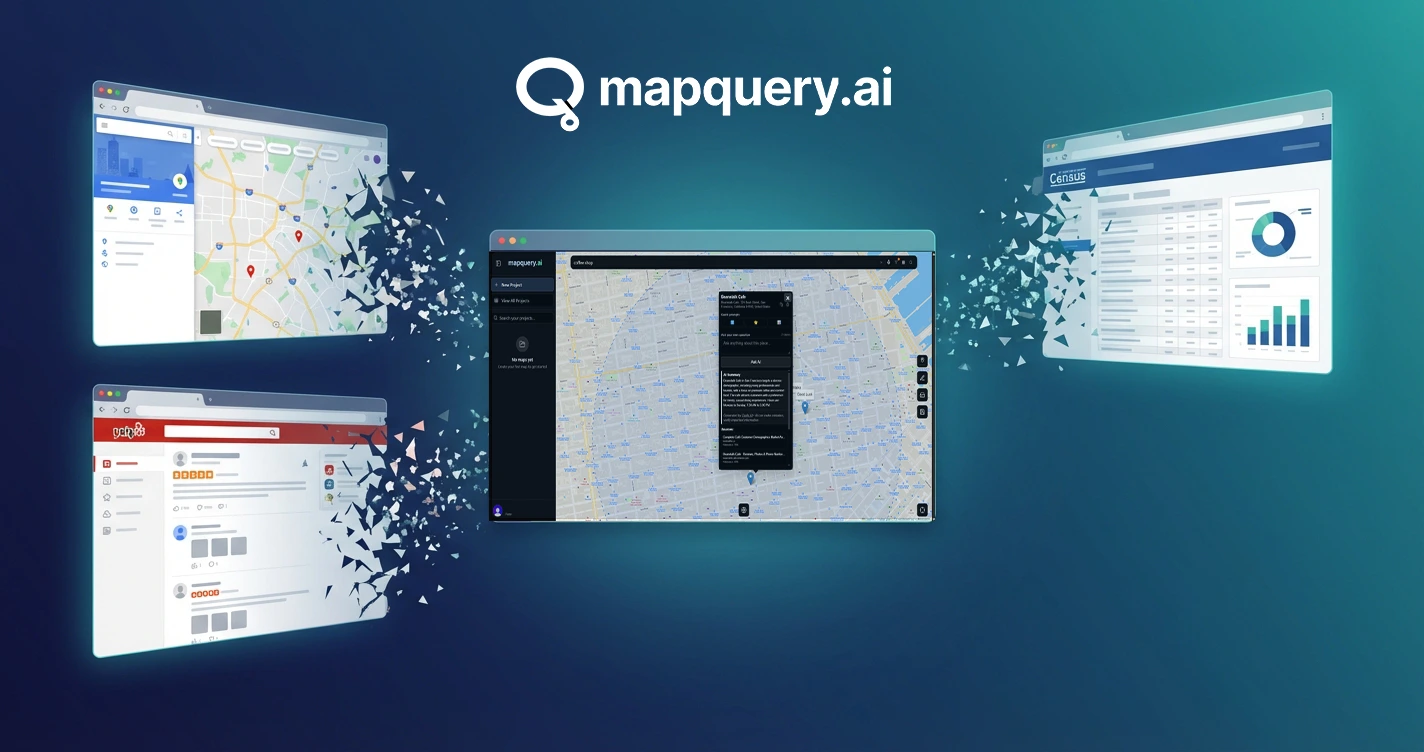
Map your competitive landscape in minutes.
Get competitor intelligence without technical expertise or high costs. 10 free searches daily.
Start for free at mapquery.ai →