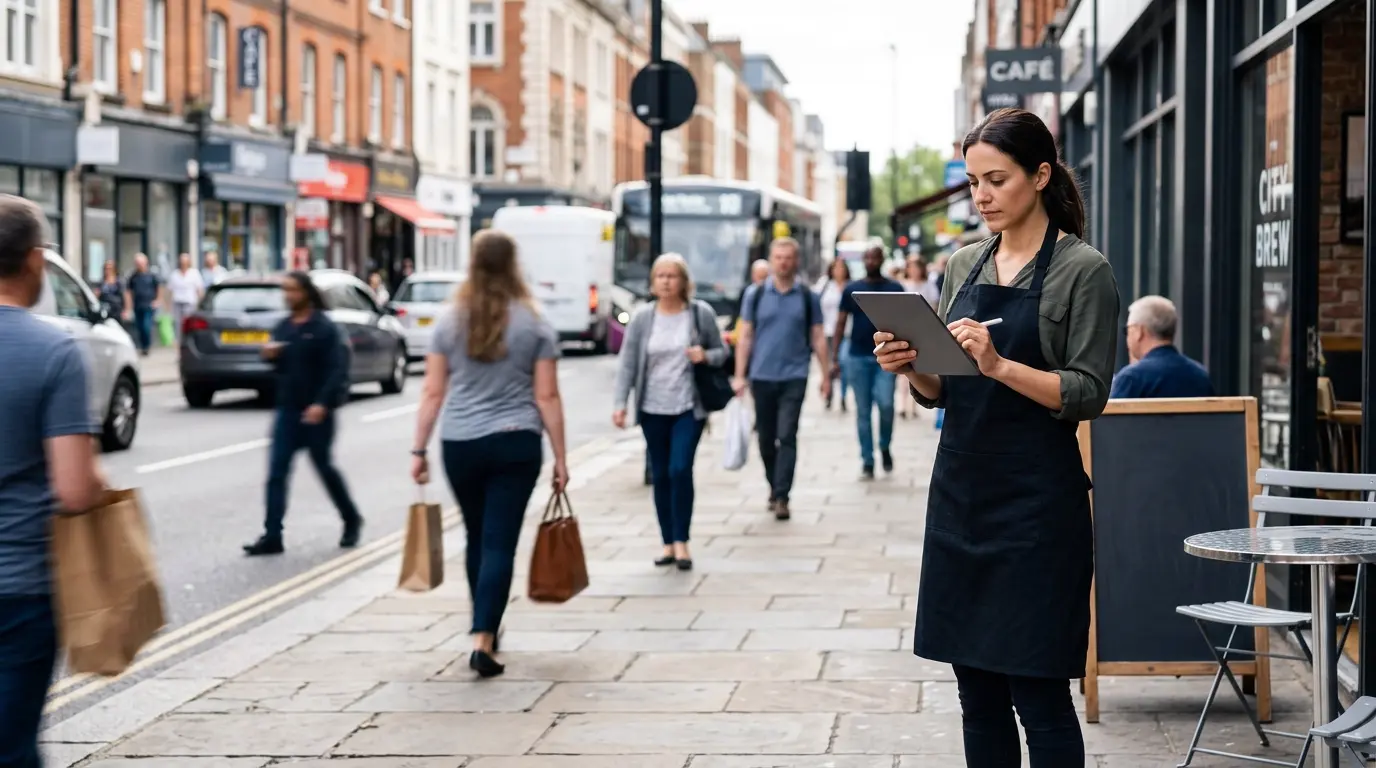
The stakes are real. About 20.4% of businesses fail in year one, and 49.4% are gone by year five (BLS 2024, via commerceinstitute.com). For franchises specifically, 60% of new units fail within three years, with poor location selection as a primary cause. The research you do before signing a lease is the research that determines whether you make it.
This guide covers the five-step framework for doing market research when location is your most important variable.
“60% of new franchise units fail within their first three years. Inadequate market research and poor location selection are primary culprits.”
Why Location Changes Everything About Market Research
Traditional market research focuses on demographics, surveys, and trend analysis. That work still matters, but for a location-based business, it’s only half the picture.
Location-based market research adds a layer that product companies never have to think about: competitive density, foot traffic patterns, trade area boundaries, and POI (point of interest) data. You’re not just asking “is there demand for this?” You’re asking “is there demand for this, here, from the people who are actually nearby?”
The key insight is that even well-executed operations can’t overcome a bad site. Location is a multiplier on everything else. A great operator in the wrong location will struggle. A mediocre operator in the right location can survive.
What is a trade area?
The geographic region from which a business draws the majority of its customers. Not a circle on a map. It reflects actual travel patterns, barriers, and competitive context. The primary zone typically accounts for 50%+ of sales.
What is POI data?
Structured data about physical business locations: name, category, address, coordinates, hours, reviews. Used to map competitive landscapes and identify market gaps by tools like MapQuery.ai and Placer.ai.
The 5-Step Market Research Framework for Location-Based Businesses
Step 1: Define Your Trade Area
Before you can research a market, you need to define it. A trade area is the geographic region from which a business draws the majority of its customers, shaped by travel behavior, not just distance.
Business Type | Primary Trade Area |
|---|---|
| Coffee shop / fast food | 1–2 mile radius / 5–10 min drive |
| Casual dining / grocery | 3–5 mile radius / 15–20 min drive |
Specialty retail / boutique | 5–10 mile radius / 20–30 min drive |
Regional shopping destination | 15–30 min drive |
Experiential / destination | 45–90 min drive |
Key factors that shape trade area boundaries: geographic barriers (rivers, highways, rail lines), psychological barriers, transportation mode, and competitive alternatives nearby. If you have an existing location, map where your actual customers come from via ZIP code analysis. That’s your real trade area.
Step 2: Map Your Competitive Landscape
Once you’ve defined your trade area, identify every direct competitor operating within it. You’re looking for three things: competitive density (how many competitors per square mile), clustering patterns (grouped vs. spread out), and market gaps (demand signals with low competitor presence).
Competitive clustering isn’t always bad. In categories where customers comparison-shop (jewelry, furniture, restaurants) clusters create destination appeal. In convenience categories like coffee, pharmacy, and fast casual, dense clustering cannibalizes demand. Know which type you are before interpreting what you see on the map.
Step 3: Analyze Demand Signals

Mapping competitors tells you about supply. Now you need to understand demand.
The key metric is often daytime population, not residential population. A downtown office district may have 10,000+ daytime workers but minimal residents, which is critical context for a lunch-focused concept (piinpoint.com). GPS-based foot traffic data is accurate to roughly 5–10 meters.
Beyond raw foot traffic, look for: nearby anchor businesses (gyms, grocery stores, offices, entertainment venues), population density and household income, daytime vs. nighttime population split, and complementary business density.
High foot traffic does not equal high sales. A location with heavy traffic but poor conversion (wrong customer type, bad visibility, no parking) can underperform a lower-traffic location with perfect alignment. Always cross-reference traffic volume with traffic type.
Step 4: Research Your Competitors Directly

Secondary data tells you what exists. Competitor research tells you how well they’re executing and where they’re falling short.
Review analysis: Pull reviews from Google My Business, Yelp, Facebook, and industry-specific platforms. Look for recurring complaints (service gaps you can fill), recurring praise (what customers value most), pricing signals, and recent changes. MapQuery.ai generates AI research reports per competitor automatically, saving hours of manual research.
Mystery shopping: Visit 3–5 top competitors as a customer. Document wait times, greeting quality, cleanliness, menu range, pricing, staff knowledge, and transaction efficiency. Use the same checklist for each visit. A structured program runs $5,000–$15,000 (intouchinsight.com); a DIY version costs nothing but time.
Step 5: Validate with Primary Research
Secondary data tells you what exists. Primary research tells you whether your specific concept will resonate with the people in your trade area. Don’t skip this step.
Intercept surveys
Approach people exiting competitor locations. Ask about habits, price sensitivity, and likelihood to try a new concept. Cost: $5,000–$25,000 or free DIY with 10–15 conversations.
Online surveys
Good for validating demand and testing concept positioning. Budget $5,000–$15,000 for 400 targeted responses.
Soft launch / pop-up
Lowest-cost real-world test. Farmers markets, food halls, temporary retail spaces. Validates demand with actual purchase behavior, not stated intent.
Focus groups
$7,000–$20,000 per group. Best for testing new concepts and understanding the “why” behind customer preferences.
What Does Market Research Cost for a Small Business?
Here’s a realistic cost reference for the full range of research methods:
Research Method | Typical Cost | Best For |
|---|---|---|
Secondary research (census, online) | $0–$5,000 | Initial screening |
| Demographic analysis | $2,000–$10,000 | Trade area profiling |
| Foot traffic analysis | $1,000–$6,000 | Demand validation |
| Mystery shopping | $5,000–$15,000 | Competitor intelligence |
Online survey (400 responses) | $5,000–$15,000 | Customer validation |
| Intercept survey | $5,000–$25,000 | On-the-ground insights |
| Focus group | $7,000–$20,000 | Concept testing |
Full location research package | $15,000–$50,000 | Single location decision |
6 Common Market Research Mistakes
- Defining trade areas by assumption, not data
Operators consistently underestimate customer travel distances and ignore geographic barriers. Use actual customer data or mobility data, not circles on a map.
- Confusing “no competitors” with “no demand”
An empty market might mean untapped opportunity. Or it might mean others already tried and failed. Investigate why competitors are absent before calling it a whitespace.
- Ignoring daytime population
Residential population is the wrong metric for lunch-focused restaurants, office-adjacent retail, and B2B services. Map who’s actually present during your operating hours.
- Overconfidence in forecasting models
Models explain historical patterns. They don’t predict operational execution, manager quality, or competitive responses. Treat model outputs as one input, not a verdict.
- Skipping primary research entirely
Secondary data tells you what exists. It doesn’t tell you whether your specific concept will resonate with the people in that trade area. At minimum, have 10–15 real conversations.
- Ignoring cannibalization risk for multi-unit expansion
When cannibalization exceeds roughly 20%, a new location may not be worth opening even if the market looks attractive. Always model the impact on existing locations before committing.
Real-World Examples
Here’s how different operators used market research to make better location decisions:
Franchise Owner Evaluating a Second Location
A successful first-unit operator mapped existing franchise locations and direct competitors in three candidate markets, analyzed daytime population, and compared demographics against their first unit’s customer ZIP codes. Market 1 was oversaturated. Market 2 had a genuine gap with matching demographics. Market 3 had traffic but the wrong income profile. They opened in Market 2. This mirrors how Pollo Campero used location intelligence and regression modeling to identify the top 500 intersections nationwide for franchise expansion.
Independent Cafe Scouting a New Neighborhood
A single-location cafe mapped all coffee shops in the target neighborhood, cross-referenced foot traffic data, and visited the top three competitors as customers. One block had low competitor density, high office worker daytime population, and a gap in quality coffee. The existing competitors were all chains. They signed a lease on that block and differentiated on quality and neighborhood feel.
Real Estate Broker Building a Retail Tenant Pitch
A commercial broker mapped all businesses in the trade area by category, identified which retail categories were underrepresented relative to population density, and pulled competitor review data to show service gaps. The corridor had strong foot traffic anchors (a grocery store and a gym) but no specialty coffee or fast-casual dining. The broker used the competitive map as the visual centerpiece of the pitch deck. The tenant signed.
Frequently Asked Questions
What is market research for a small business?
Market research for a small business is the process of gathering and analyzing information about your target customers, competitors, and market conditions before making major business decisions. For location-based businesses, this includes trade area analysis, competitive mapping, foot traffic data, and primary research like surveys or customer interviews.
How do I find competitors in my area?
The fastest way is to use a location intelligence tool like MapQuery.ai. Search by business type and location to get an interactive map of competitors with AI-powered research reports for each one, faster and more actionable than manual search on Google Maps.
How much does market research cost for a small business?
Market research for a small business can range from free (using census data and online tools) to $50,000 or more for a full location research package. Competitive mapping tools like MapQuery.ai start free. A realistic budget for a single location decision (including demographic analysis, foot traffic data, and some primary research) is $5,000–$20,000.
What is a trade area in retail?
A trade area in retail is the geographic region from which a business draws the majority of its customers. It’s defined by actual travel behavior, not just distance, shaped by geographic barriers, transportation modes, and competitive alternatives. The primary trade area typically accounts for 50% or more of a business’s total sales.
Can I do market research myself without hiring a firm?
Yes. You can do meaningful market research yourself using free tools like the U.S. Census Bureau, Google My Business, and MapQuery.ai’s free tier. The most valuable DIY step is having 10–15 real conversations with target customers in your trade area. No budget required, and the insights are often more useful than expensive surveys.
What is POI data and why does it matter?
POI data (point of interest data) is structured information about physical business locations, including name, category, address, coordinates, hours, and reviews. It matters for location-based businesses because it’s the foundation of competitive mapping and market gap analysis. Tools that use POI data can show you exactly which competitors are operating in your trade area and where the gaps are.
What’s the difference between foot traffic data and demographic data?
Demographic data describes who lives in an area: age, income, household size. Foot traffic data describes who actually visits an area and when. For location-based businesses, foot traffic data is often more actionable because it reflects actual behavior, not just residential population. A neighborhood with low residential density but high daytime foot traffic can be an excellent location for the right concept.
Final Thoughts
Market research for a location-based business comes down to one core question: is there enough of the right demand, in the right place, with enough room for you to compete? The five-step framework (define your trade area, map competitors, analyze demand signals, research competitors directly, and validate with primary research) gives you a structured way to answer that question before you sign a lease.
The research doesn’t have to be expensive. Start with the competitive landscape. Understand who’s already operating in your trade area and where the gaps are. That alone will tell you more than most operators know before they open.
For more on the tools that make this research faster, see Best Competitor Analysis Tools for Location-Based Businesses and Best Market Research Tools for Small Business Owners.
Try MapQuery.ai Free for Location-Based Market Research
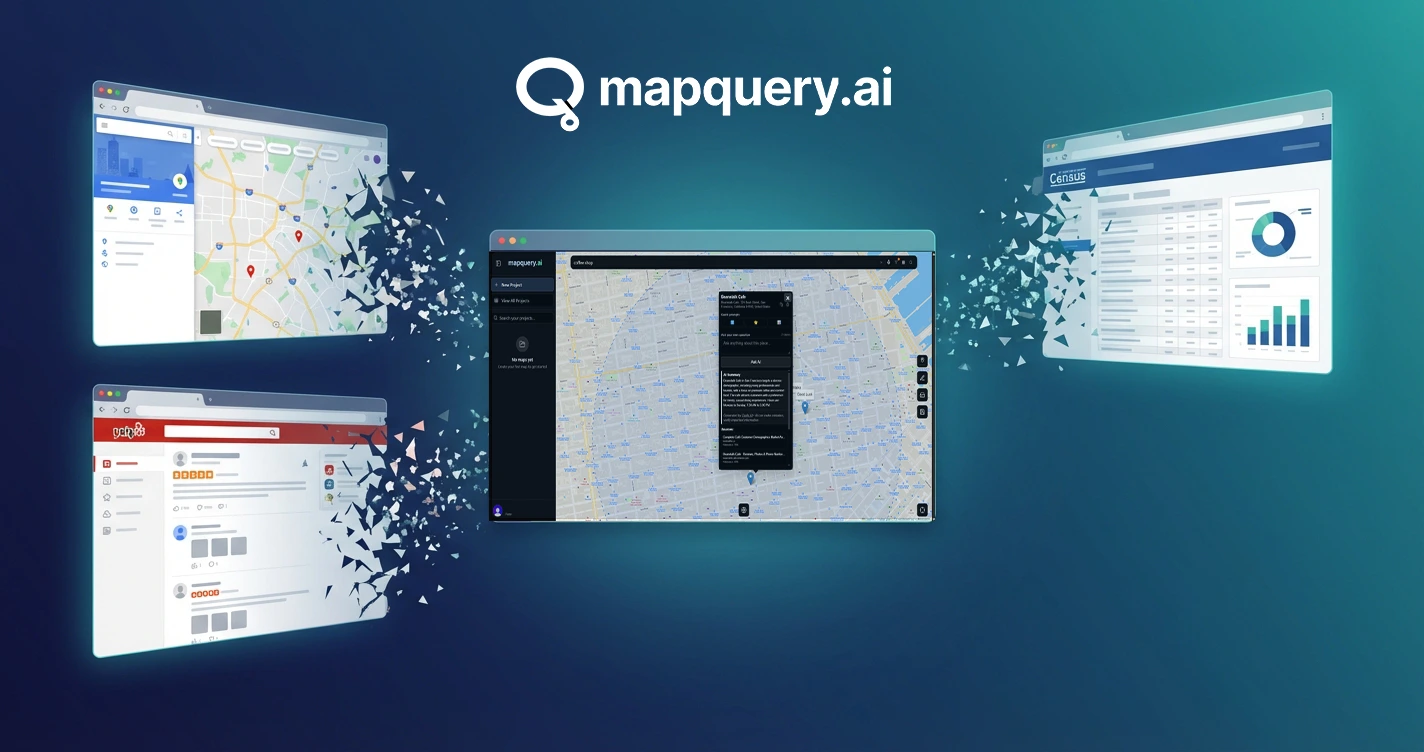
Map your competitive landscape in minutes.
Get competitor intelligence without technical expertise or high costs. 10 free searches daily.
Start for free at mapquery.ai →