Knowing how to choose a profitable location for your new cafe may be the single decision that determines whether your business survives its first year. Location is not a detail you can fix later. It is the foundation that shapes your revenue ceiling, your customer base, and your operational costs from day one.
The coffee market has shifted dramatically. Right now, 59% of all U.S. coffee purchases occur at drive-thrus, a record high according to the National Coffee Association. This means the physical format and position of your site directly determines how much revenue you can capture before you even open the doors. A cafe on a busy pedestrian street will perform differently than one on a high-speed arterial road, even if both have similar demographics nearby. The difference is not marginal. It can be the difference between profitability and failure.
This guide breaks down the five core factors that determine site viability: foot traffic patterns and timing, competitor density and sentiment gaps, accessibility and visibility, rent-to-revenue ratios, and neighborhood growth signals. You’ll also learn how to validate your decision with live data before you sign a lease. By the end, you’ll have a framework to evaluate any candidate location with the same rigor you’d apply to any other major business investment.
Why Location Is the Biggest Variable in Cafe Profitability
Most new cafe owners focus on equipment, branding, and menu development. Location research gets compressed into a few weekend walk-arounds and a gut feeling about whether a street “feels right.” That approach is expensive.
A poorly chosen location means you spend years fighting for customers rather than serving the ones who would naturally walk past your door. Location determines your baseline revenue ceiling before you brew a single shot. It sets your average ticket volume, your peak hours, and how often your regulars return.
Unlike a menu you can revise or a brand you can reposition, a lease locks you in for years. Getting the site decision right the first time is the foundation of everything else.
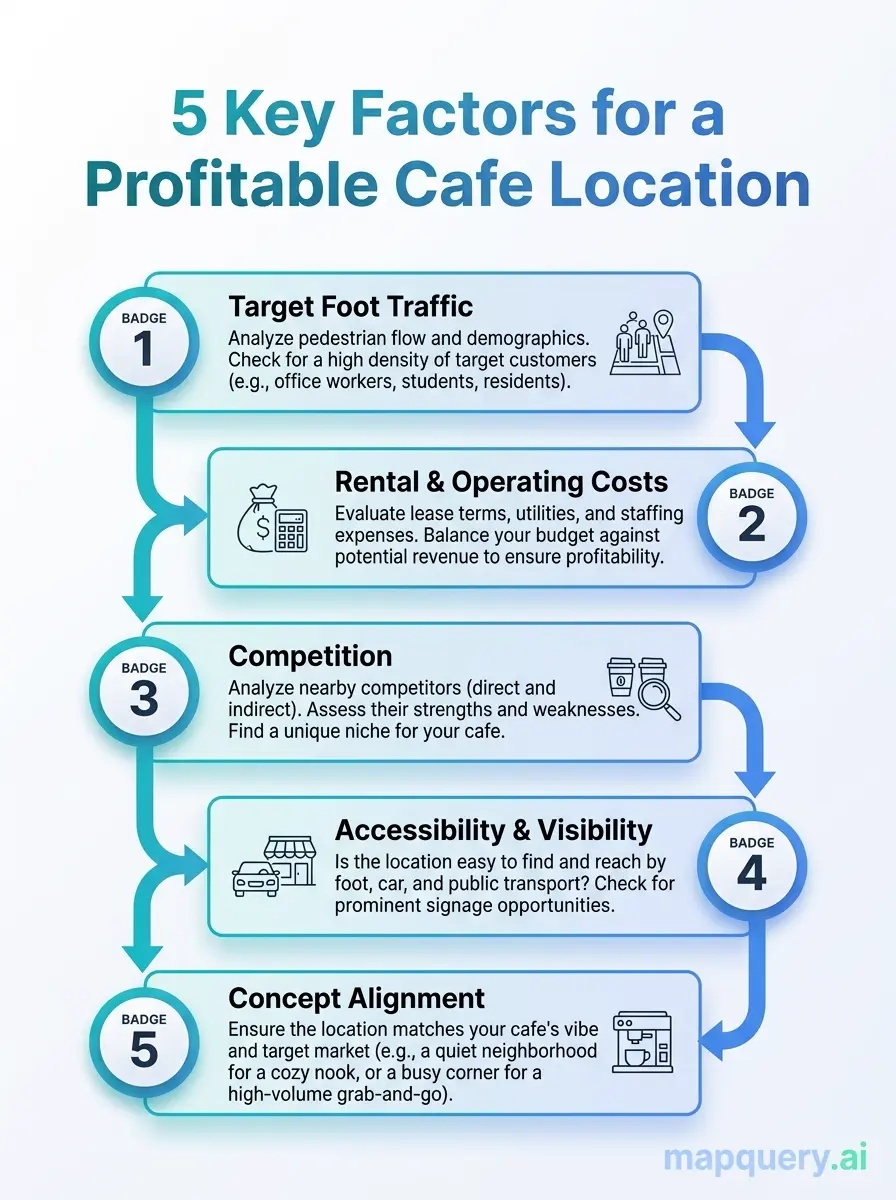
Five key factors for a profitable cafe location: foot traffic, competitor
gaps, accessibility, rent ratio, and neighborhood trajectory.
How to Choose a Profitable Location for Your New Cafe
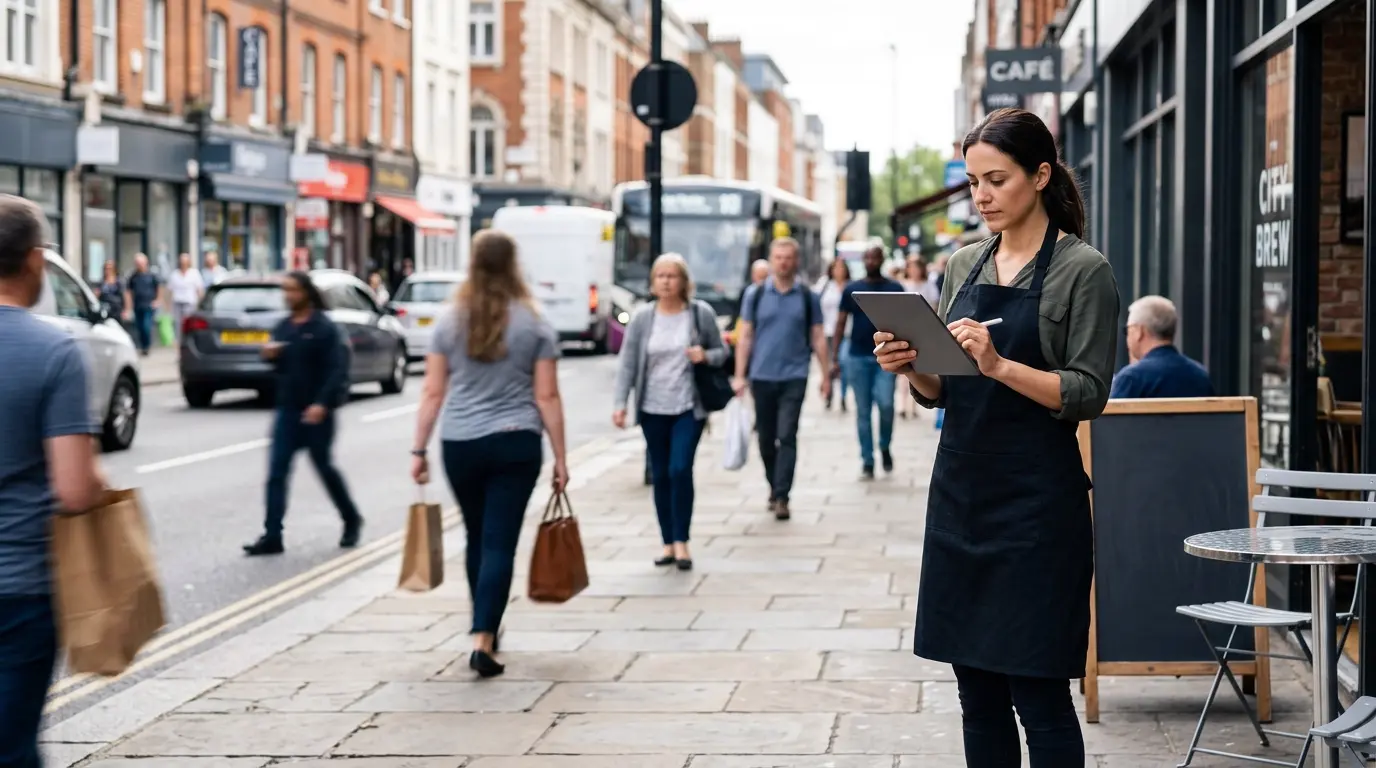
Foot traffic is your primary revenue engine, especially in the first 12 months when your brand awareness is still building. A site with natural pedestrian flow brings you customers who did not seek you out, which means lower marketing spend and faster payback on your build-out investment.
Do not rely on general impressions. Visit the site on a Tuesday at 7:30 AM, a Wednesday at noon, and a Saturday at 10 AM. Those three windows will tell you more than any broker’s pitch. Look for consistent movement, not just peaks. A street that is busy on weekend afternoons but dead Monday through Friday will not support a cafe that depends on morning commuters and weekday regulars.
Also consider the direction of flow. If the pedestrian traffic on your target street moves toward the transit hub in the morning, make sure your entrance faces that direction. Even a 15-meter (50-foot) difference in storefront position can determine whether people see you or miss you entirely.
Market Insight
75% of all restaurant traffic is now off-premises, including takeout, drive-thru, and delivery orders.
This shift means your site evaluation needs to go beyond interior seating. Curb-side pickup zones, delivery driver access, and drive-thru viability are now primary filters, not secondary considerations, when choosing a profitable cafe location.
Understand Your Target Customer Before You Pick a Street
A cafe targeting remote workers needs a different site than one targeting morning commuters. Both need foot traffic. But they need it from different people, at different times, in different kinds of neighborhoods.
Define your primary customer segment first. Then ask where that segment spends time between 7 AM and 2 PM on a weekday.
Commuter-focused cafe
Prioritize locations within a 3-minute walk of train stations, bus terminals, or ferry stops. Morning traffic volume is your key metric.
Remote-worker cafe
Look for residential neighborhoods with high apartment density, low existing coworking supply, and streets with slow pedestrian movement that encourages lingering rather than rushing past.
Weekend lifestyle cafe
Target areas with complementary retail such as bookstores, boutiques, and fitness studios that draw your demographic for leisure rather than transit.
Once you have a customer profile, you can map candidate sites against real behavioral data rather than guessing which neighborhood “feels right” for your concept.

How to Evaluate Competitor Density Before Signing a Lease
Competitor density research answers two questions. First: is this area already oversaturated? Second: if there are competitors nearby, are any of them doing a poor job? Saturation is not always a dealbreaker. Some of the most profitable cafe locations sit in dense competitor clusters because those clusters signal genuine, validated demand. The risk is entering a market where one dominant operator has already captured the majority of loyal customers.
The real opportunity sits where demand exists but service quality does not. Look for competitor locations with strong review volume but recurring complaints about slow service, inconsistent quality, or a poor atmosphere. That gap is where you can win.
Use a tool that pulls live review data rather than a static directory. Customer sentiment shifts over time, and a competitor that was thriving 18 months ago may now be struggling. You want to know the current situation, not the historic one. MapQuery.ai’s competitor mapping workflow pulls live data from Instagram, Yelp, and TripAdvisor so you can see actual customer feedback on every nearby business in your target area, all without leaving your desk. For a broader look at the tools available, see our guide on best competitor analysis tools for location-based businesses.
What Actually Drives Walk-In Revenue
Accessibility and visibility are related but not the same. Visibility is whether someone can see your signage. Accessibility is whether they can actually stop and get in without friction. A cafe on a high-speed arterial road might have enormous visibility but near-zero walk-in rate if there’s no parking, no safe pedestrian crossing, and no reason to slow down.
Walkable, lower-traffic streets consistently generate stronger habitual visit patterns than busy roads. According to Transport for London, pedestrians and cyclists spend 40% more per month at local shops than car drivers, driven by the higher frequency of impulse visits that walkable environments produce. If your concept depends on repeat, daily visits rather than destination traffic, a “quieter” street is often a stronger revenue environment.
Key accessibility criteria to evaluate for any candidate site:
- Distance to the nearest transit stop (target under 4 minutes on foot)
- Parking availability within 100 meters (about 300 feet) for car-dependent areas
- Pedestrian crossing points directly adjacent to the entrance
- Delivery vehicle access for inventory without blocking the entrance
- Disability access compliance to avoid costly post-lease retrofits
Visibility criteria include: street-level frontage, signage height relative to pedestrian sightlines, and whether foot traffic naturally faces your storefront or walks with their back to it.

Rent-to-Revenue Ratio, The Number Most Cafe Owners Ignore
Location quality is meaningless if the rent destroys your margins before you hit breakeven. According to Arizona Central, most successful cafe operators target a rent-to-revenue ratio between 8% and 12% of projected monthly gross sales.
That means if your target site costs $5,000 per month in rent, you need to project at least $41,000 to $62,000 in monthly revenue for the location to be financially viable under standard operating cost assumptions. If your honest, conservative model puts rent above 15% of projected revenue, the site carries too much financial risk, regardless of how good the street looks on a Saturday afternoon.
Build that projection from the bottom up. Estimate average ticket size, daily transaction volume at realistic foot traffic conversion rates, and your operating days per month. Do not use optimistic projections. Use conservative ones and check whether the site still works. According to Vast CFO, occupancy costs should fall within a target range of roughly 6-10% of revenue for many restaurant concepts.

Neighborhood Growth Signals That Predict Cafe Success
A site that works today needs to still work in year three and year five. Neighborhoods change, and those changes affect your customer base, your rent on renewal, and your competition level.
Positive growth signals to look for include new residential construction within a half-mile radius, increasing density of complementary retail (boutiques, fitness studios, specialty food), rising review volumes on nearby hospitality venues, and visible commercial renovation activity. Negative signals include vacant storefronts that have sat empty for more than 12 months, declining review volume on nearby anchors, and a business mix dominated by discount retail or short-term tenants.
One underused research method is analyzing the review trajectory of nearby businesses over the past 12 months. If the neighborhood’s best-reviewed venues are collecting more reviews per month now than they were a year ago, that is a strong signal of growing residential and visitor traffic. The reverse is also true. You can pull this kind of trend data quickly using MapQuery.ai’s commercial real estate research workflow, which surfaces AI-generated market context and customer sentiment patterns for any property you are evaluating.
Did You Know?
Coffee shops within a 2-3 minute walk of major office clusters see 11-15 visits per month per customer, compared to just 7-9 visits for those located further away.
Proximity to workplaces does not just increase traffic volume. It nearly doubles the visit frequency of your most loyal regulars, which directly impacts lifetime customer value and monthly revenue predictability.

How to Choose a Profitable Cafe Location Using Live Data
Traditional location research relies on broker opinions, dated demographic reports, and manual site visits. The problem is that all three give you a lagging picture of a neighborhood that may have changed materially in the past 12 months.
Live data tools pull current information from the platforms your potential customers actually use: Google Maps, Yelp, TripAdvisor, and Instagram. That means you are seeing what customers are saying and doing right now, not what they were doing when the last market report was published.
When we evaluate candidate sites using live data, the research process looks like this:
Step 1
Map all relevant business types within a 5-minute walk of each candidate site.
Step 2
Identify review volume, average rating, and recurring themes in customer feedback for each nearby cafe.
Step 3
Ask plain-English questions like “What do customers complain about most at cafes near this address?” or “Is this area showing growth or decline in hospitality traffic?”
Step 4
Store findings into a project so you can compare multiple sites side by side with consistent data sets.
Step 5
Re-run the data before your lease negotiation to confirm conditions have not shifted since your initial research.
What once required weeks of manual research can now be completed in under two hours per site. MapQuery.ai’s Find Locations feature lets you search in plain English, instantly maps every matching result in your area, and runs a full AI research panel on any location with a single click.

New construction within a half-mile radius is one of the strongest positive
signals when evaluating a cafe site.
How Cafe Owners Use Location Intelligence
Location intelligence works differently depending on your situation. Whether you’re opening your first cafe, expanding to new markets, or validating a franchise territory, the same research framework applies. Here’s how three different cafe owners used live data to make their location decisions.
The First-Time Owner Evaluating Three Shortlisted Sites
Maya is opening her first specialty coffee shop and has narrowed her search to three locations in different parts of the same city. She creates a separate project for each address in MapQuery.ai, searches for “coffee shops” and “cafes” within a 5-minute walk of each site, and runs the AI research panel on every nearby competitor. One site has three nearby cafes with strong foot traffic but consistent complaints about cold drinks and long wait times. That recurring complaint pattern tells Maya there is validated demand and a clear service gap she can fill. She signs the lease on that site.
The Multi-Location Operator Evaluating a New Territory
Carlos operates two successful cafes and wants to open a third in a new suburb. Rather than relying on a broker’s neighborhood summary, he uses MapQuery.ai to map every cafe in the target area, check customer sentiment across all of them, and ask the AI whether review volume has grown or declined over the past year. The data shows one competitor with a 4.6 star average and increasing review frequency. That tells Carlos the neighborhood is growing and one operator is dominating it. He adjusts his search to a neighboring suburb where demand signals are similar but the competitive picture is weaker.
The Franchisee Validating a Territory Before Buying In
Priya is considering buying into a coffee franchise and wants to independently validate the territory before committing. She uses the
franchise site selection workflow in MapQuery.ai
to map competitor density, review the AI-generated market context for three candidate sites in the territory, and save her findings into a shareable project she can present to her franchise development manager. The research confirms that one of the three candidate sites sits within a 2-minute walk of two major office buildings with no existing drive-thru coffee competitor. That site becomes the primary recommendation for her franchise application.
Validate a Cafe Site Before You Commit
MapQuery.ai is an AI-powered location intelligence tool built for business owners who need to make high-stakes site decisions with real data, not assumptions. The tagline is “Smarter business decisions, backed by live web data” and that describes exactly what the tool does.
If you want a detailed walkthrough of what the tool can do before you sign up, the MapQuery.ai blog covers applied use cases across retail, hospitality, and franchise site selection. The FAQ page answers the most common questions about how credits work and what data sources the platform uses.
Final Thoughts
Knowing how to choose a profitable location for your new cafe is not about finding the prettiest street or trusting a broker’s enthusiasm. It is a research process that combines foot traffic analysis, competitor intelligence, accessibility evaluation, rent viability modeling, and neighborhood growth signals into a single, evidence-based decision.
The good news: every one of those inputs is now accessible in real time. You don’t need to spend weeks commissioning reports or hiring consultants to get a credible picture of a candidate site before you commit capital.
Use the framework in this guide to structure your evaluation. Use live data tools to validate what you find. Make the lease decision with the same discipline you would apply to any other major business investment.
Explore Cafe Locations With Live Data
Ready to test these criteria on real neighborhoods? Search MapQuery for restaurants in your target market to see foot traffic patterns, competitor density, review sentiment, and neighborhood growth signals all in one place. Start with a city you’re considering. Map the competitor clusters, read what customers are actually saying about nearby cafes, and identify the gaps where you can win.

Start Your Cafe Location Research Today
Use live data from Yelp, TripAdvisor, and Instagram to validate foot traffic patterns, analyze competitor density, check rent-to-revenue viability, and spot neighborhood growth signals before you sign a lease. Research that used to take weeks now takes hours.
Frequently Asked Questions
How do I choose a profitable location for my new cafe?
Choosing a profitable location for your new cafe requires validating foot traffic patterns during your target hours, analyzing competitor density and sentiment gaps, confirming accessibility and visibility, modeling rent against realistic revenue projections, and checking neighborhood growth signals before signing a lease.
What is a good rent-to-revenue ratio for a cafe?
Most successful cafe operators target a rent-to-revenue ratio between 8% and 12% of projected monthly gross sales. If your honest, conservative revenue model puts rent above 15% of projected monthly revenue, the site carries too much financial risk regardless of how promising the street looks.
How important is foot traffic when choosing a cafe location?
Foot traffic is your primary revenue engine, especially in the first 12 months when brand awareness is still building. A site with natural pedestrian flow brings customers who did not seek you out, which reduces marketing spend and accelerates payback on your build-out investment. Visit the site on a Tuesday morning, a Wednesday at noon, and a Saturday morning to get a realistic picture.
Should I open a cafe near competitors?
Competitor density is not automatically a dealbreaker. Dense competitor clusters often signal validated demand. The real opportunity is where demand exists but service quality does not. Look for nearby cafes with strong review volume but recurring complaints about slow service, inconsistent quality, or poor atmosphere. That gap is where you can win.
How can I use live data to validate a cafe location before signing a lease?
Tools like MapQuery.ai pull live data from Yelp, Google Maps, TripAdvisor, and Instagram so you can map competitor density, analyze customer sentiment, and ask plain-English questions about any neighborhood before committing capital. The process that used to take weeks of manual research now takes under two hours per candidate site.
What neighborhood signals predict long-term cafe success?
Positive signals include new residential construction within a half-mile radius, increasing density of complementary retail like boutiques and fitness studios, rising review volumes on nearby hospitality venues, and visible commercial renovation activity. Negative signals include vacant storefronts sitting empty for more than 12 months and declining review volume on nearby anchors.