

80% of total U.S. population growth over the last decade has happened in the Sun Belt region, according to Moody’s Analytics (Q1 2024). If you run a business or plan to open one, that number should be the first thing on your radar. The Sunbelt Surge is not a trend you can watch from the sidelines. It is a structural shift in where Americans live, work, and spend their money, and the businesses that position themselves inside it now are the ones that will have a meaningful head start over the next decade.
The Sunbelt Surge is the most significant geographic redistribution of population and purchasing power in modern U.S. history, with Southern states absorbing the majority of domestic migration, high-income households, and corporate investment. This post is for business owners and expansion planners who want to understand where the growth is happening and how to act on it.
What Is the Sunbelt Surge?
The term “Sun Belt” describes the broad arc of Southern and Southwestern states stretching from the Carolinas through Georgia, Tennessee, Florida, Alabama, Mississippi, Louisiana, Texas, and into the Southwest.
What has changed is the scale and speed. The Sunbelt Surge is no longer just about retirees moving to Florida. It is about working-age families, high earners, and major corporations making deliberate decisions to relocate south.
Lower state income taxes in places like Texas and Florida have remote work flexibility, housing affordability relative to the coasts, and a regulatory environment that business owners consistently rate as friendlier. The result is a self-reinforcing cycle. People move. Businesses follow. Jobs grow. More people move.
The Migration Numbers Behind Southern U.S. Dominance
The South is not just growing, it is absorbing the vast majority of America’s domestic migration. This is not a temporary blip or a regional preference. It is a sustained, structural shift in where Americans are choosing to live and build their futures.
The Southeast corridor, including Charlotte, Nashville, Raleigh, Jacksonville, and Tampa, is absorbing population at a rate that older metros in the Northeast and Midwest simply cannot match. These cities are not just growing. They are thriving. For business owners, this tells you something concrete: the customer base is moving, and it is moving south. The people who would have opened a business in Boston or Chicago five years ago are now looking at Nashville or Charlotte. That shift in where customers are located is the most important data point for any expansion decision.
Market Insight
Two-thirds (66.6%) of all moves in 2025 were destined for the Sun Belt states.
Two in every three Americans who relocated in 2025 chose a Sun Belt destination. This is not a marginal preference. It is the dominant choice. If your business is not inside that footprint, or at least aware of it, you are planning with an incomplete picture of where the market is going. The migration is accelerating, and the window to establish presence in high-growth markets before they become saturated is narrowing. Businesses that understand this trend and act on it now will have a structural advantage over competitors who are still focused on traditional markets.
Why the Sunbelt Surge Is Your Biggest Retail Opportunity
Brick-and-mortar retailers, franchise operators, and consumer brands are finding unprecedented opportunity in Sun Belt markets. These are high-growth regions with strong foot traffic and rising household income. The fundamentals are there. Southern metros are producing some of the strongest retail metrics in the country. Charlotte, NC ranked as the number one retail market in 2026, recording 7.4% growth in asking rents and an 11.6% total return for investors, according to Forbes and Bisnow. Tampa showed similar strength.
But there is a critical caveat. Sunbelt retail markets move fast. A location that looks great on paper today may face new competition within 12 months as other operators spot the same opportunity. You need current data, not data from last quarter. The window to claim the best sites in emerging markets is narrowing. Retail sales in 2026 are tracking above the prior year, and the pattern inside Sun Belt cities shows that shoppers who do visit stores are buying more intentionally. The visit-to-purchase conversion is strong in these markets, which matters for operators evaluating whether a new location will perform. But that strength is attracting attention from well-capitalized competitors who are also reading the same data.
If you are evaluating which tools to use for this kind of research, see our guide to the best AI site selection tools for 2026 for a breakdown of what each platform does well.
How Southern U.S. Dominance Is Reshaping HQ Decisions
Companies planning regional office expansions, HQ relocations, or new market entry are increasingly looking south. The data supports the move. Dallas scored a perfect 100 on the corporate headquarters relocation index between 2018 and 2024, with Austin close behind at 81, according to Pebb Capital’s analysis. These relocations bring high-salaried workforces who then fuel demand for housing, restaurants, fitness studios, professional services, and more. The economic multiplier effect is real. When a major employer relocates to a Sun Belt market, it doesn’t just bring jobs. It brings spending power and attracts an entire ecosystem of supporting businesses.
The corporate surge in markets like Austin and Dallas has also pushed commercial real estate costs higher than they were five years ago. The arbitrage against coastal cities still exists, but it has narrowed in the most in-demand submarkets. Companies that moved early captured significant cost advantages. Companies moving now will find the advantage smaller, though still meaningful compared to staying in traditional tech hubs or financial centers.
Employment in the Sun Belt grew by 13 million jobs, a 20% increase, over the last decade. That is double the 9% growth rate seen in non-Sun Belt regions, according to Clarion Partners. For service businesses, that kind of employment growth creates a sustained base of potential customers. More jobs mean more people with disposable income, more demand for services, and more opportunity for businesses that can position themselves in the right locations.

Riding the Sunbelt Surge as a Service Business
Professional services, healthcare practices, gyms, salons, childcare providers, and any business that earns revenue from repeat local customers are positioned to benefit from Sun Belt growth. A growing population means a growing local customer pool. The fundamentals are strong. 94% of Southern businesses reported strong customer interest in their products or services in mid-2025, according to Capital Analytics. That level of market confidence is not something you typically see in stagnant or declining regions. When people are moving into a market and spending money, service businesses have a natural tailwind.
But there is a real challenge to navigate. New residents take time to develop loyalty to local providers. Service businesses entering a high-growth Sun Belt zip code will need to compete for attention early and often, especially against established brands that entered the market a year or two ahead of them. The first-mover advantage is real in service businesses. If a fitness studio or dental practice establishes itself before the market becomes saturated, it can build a loyal customer base that is hard to displace. But if you enter after the market is already crowded, you will be fighting for every customer.
The broader business environment supports growth. 86% of Southern business leaders rate their regional economy as strong, according to the Bush Center. That confidence translates into more B2B spending, more supplier relationships, and a healthier local ecosystem for small and mid-sized operators. Service businesses benefit from this ecosystem. When the overall economy is strong and businesses are investing, there is more demand for professional services, more money for discretionary spending on fitness and wellness, and more hiring that creates demand for childcare and other support services.
High-Income Migration and the Sunbelt Surge
Population growth alone does not move the needle for premium or specialty businesses. The income profile of who is moving matters just as much as the raw headcount.
Florida gained a net total of 29,771 high-income households in a single year, the highest in the nation, according to Institutional Real Estate, Inc. The average household income for high earners moving into South Carolina is $501,205, according to SmartAsset.
These are not retirees living on fixed incomes. These are working professionals, business owners, and investors who spend on luxury goods, boutique fitness, private education, financial services, and high-end dining. If your business targets that segment, the Sun Belt is where the customer migration is happening.
Market Insight
By 2040, the Sun Belt is projected to hold 55% of the total U.S. population.
Source:
Institutional Real Estate, Inc. 2024
Majority of Americans living in the South by 2040 is not a projection you can plan around later. The businesses that establish presence, brand recognition, and customer loyalty now are the ones that will have compounding advantages when the population milestone hits.
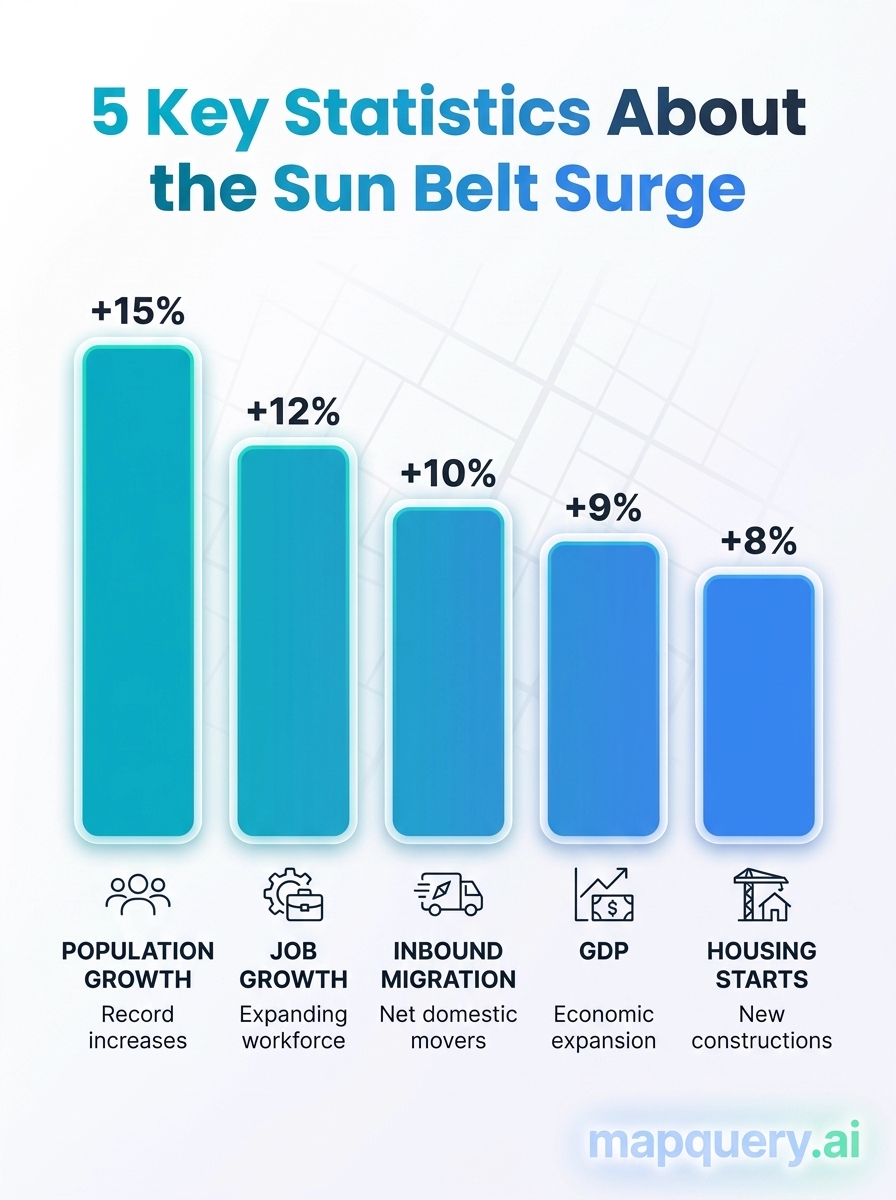
Five key statistics illustrate how the Sunbelt Surge is reshaping the Southern U.S. in population and economic growth.
Who Benefits Most from the Sunbelt Surge
The Franchise Operator Planning a Third Location
Maria’s two Ohio locations have seen flat growth for two years. She’s eyeing Nashville and Charlotte. Using MapQuery.ai, she maps competitor density with See What’s Around You and reads real customer feedback with Customer Pulse. Within an afternoon she has a short list of sites where competition is thin and foot traffic is strong.
The Commercial Real Estate Investor
David is comparing retail strip centers in suburban Atlanta and Tampa and needs to know which neighborhoods have real consumer activity, not just good census numbers.
He queries business density and review sentiment with Just Ask a Question, then saves each candidate to a separate project with Save Your Research so everything is organized when he presents to his investment committee.
The Boutique Fitness Studio Owner
Keisha knows high-earning households are moving into South Carolina, but she needs to know exactly which zip codes to target for her second Pilates location.
She pins high-inflow residential areas with Saved Map Markers and cross-references them against premium fitness competitor density. High income inflow plus low competition becomes her short list.
How to Find Your Best Location in a Sunbelt Market
Knowing the Sunbelt is growing is the easy part. Knowing exactly which block, corridor, or zip code within a booming Sun Belt city is right for your business is where the work actually happens.
Step 1: Define your radius
Most brick-and-mortar businesses draw from a 1-3 mile primary trade area. Start with that boundary around your candidate sites.
Step 2: Map the competition
Use MapQuery’s core location intelligence features to see every business in your category within that radius. A block full of busy, well-reviewed competitors is a sign of proven demand. A block with empty storefronts is worth questioning.
Step 3: Read customer sentiment
Reviews on Instagram, Yelp, and TripAdvisor tell you whether the area feels lively or is struggling. MapQuery’s Customer Pulse pulls this in real time, not from a static snapshot.
Step 4: Save everything
You will look at more than three sites. Use Saved AI Results and Save Your Research to keep your findings organized by location so you can compare them honestly later.
Step 5: Track the neighborhood trajectory
New businesses opening nearby, rising asking rents, and positive review sentiment are all leading indicators that a location is in an upward trend, not a peak.
You can start this process today on MapQuery.ai. The free tier gives you 10 daily research credits, up to 3 saved projects, and up to 50 locations per project.
Why Southern U.S. Dominance Is a Decade-Long Play
The Sunbelt Surge is not a cyclical uptick. It is a structural demographic shift driven by tax policy, climate preference, housing economics, and remote work flexibility. None of those drivers are reversing in the near term.
The 2040 population projection puts more than half of all Americans in the Sun Belt. The businesses that build brand recognition, customer loyalty, and operational infrastructure in these markets now will be the incumbents when that milestone arrives.
There is also a compounding network effect. When high-income households move to a market, they attract the services they were used to in their origin city. Specialty grocers, high-end fitness studios, private schools, and boutique medical practices all follow the wealth migration. If you operate in any of those categories, you are looking at a customer base that is actively looking for providers like you.
The key risk is speed. These markets are attracting attention from well-capitalized operators who read the same data you do. Acting on good location intelligence now is different from acting on it two years from now, when the best sites are already leased and the most favorable competitive windows have closed.

How MapQuery.ai Helps You Navigate the Sunbelt Surge
Location intelligence is only useful if it is current. The Sunbelt markets are moving fast, and a data set from six months ago may not reflect the competitive landscape that exists today on a given street in Charlotte or Tampa or Nashville.
MapQuery pulls live data from sources including Yelp, Google Maps, TripAdvisor, and Instagram. That means when you run a competitor scan or read customer sentiment for a location, you are seeing what is actually happening right now, not a static snapshot from a prior quarter.
See What’s Around You
Map every business in any category within your chosen radius.
Just Ask a Question
Run natural language queries about a specific address or area without building custom reports.
Customer Pulse
Read aggregated review sentiment to gauge whether a neighborhood is gaining or losing momentum.
Saved Map Markers
Pin candidate locations and keep your research geographically organized.
Save Your Research
Keep your findings, notes, and comparisons in organized projects you can return to later.
Saved AI Results
Store AI-generated insights so you can reference them without re-running the same queries.
The Pro tier gives you 1,000 monthly credits, 10x deeper research per query, unlimited projects, and up to 500 locations per project. See current pricing at mapquery.ai/pricing. For teams evaluating multiple Sun Belt markets simultaneously, that depth and scale makes a meaningful difference in the quality of decisions you can make.
If you are new to the platform, the MapQuery FAQ and documentation walks through each feature with practical examples. And if you want to see how other business owners are using location data to make expansion decisions, the MapQuery blog covers real use cases regularly.
FAQ
What exactly is the Sunbelt Surge and why is it important for business
owners in 2026?
The Sunbelt Surge refers to the accelerating population and economic growth happening across Southern U.S. states including Texas, Florida, Georgia, the Carolinas, Tennessee, and surrounding markets. It is important for business owners in 2026 because it represents the largest geographic concentration of new customers, rising household incomes, and corporate investment in the country, making the South the highest-priority region for new location planning and expansion decisions.
Which specific Sun Belt cities show the strongest business opportunity right
now?
Charlotte, NC currently ranks as the number one retail market in the country with 7.4% growth in asking rents and an 11.6% total return for investors. Dallas and Austin lead in corporate headquarters relocations. Nashville, Tampa, Raleigh, and Jacksonville are consistently appearing in top-tier migration destination lists, all of which correlate with strong consumer spending and demand for local services.
Is the Sunbelt Surge actually sustainable, or is it just a short-term trend?
The Sunbelt Surge is driven by structural factors, including lower state income taxes, remote work flexibility, relative housing affordability, and a business-friendly regulatory environment, none of which are showing signs of reversal. The projection that 55% of the total U.S. population will live in the Sun Belt by 2040 points to a multi-decade trend, not a cyclical spike.
How does a business owner identify the best specific location within a
booming Sunbelt market?
The best approach combines macro data (population inflow, income levels, employment growth) with micro-level, street-specific intelligence. You need to know competitor density, customer sentiment, and neighborhood trajectory for the specific block or zip code you are evaluating, not just the city as a whole. Tools like MapQuery.ai pull live data from Google Maps, Yelp, and TripAdvisor so you can assess those granular details before committing to a location.
What types of businesses benefit most from locating in a Sunbelt Surge
market?
Retail businesses benefit from rising foot traffic and household spending. Service businesses benefit from a growing local customer pool and high business confidence among regional operators. Businesses targeting high-income consumers benefit specifically from the wealth migration patterns, where households with incomes above $500,000 are relocating in large numbers to states like Florida, Texas, and South Carolina. Corporate service providers benefit from the large number of headquarters relocations bringing high-salaried workforces into Sun Belt metros.
How do I use location data tools to act on the Sunbelt Surge without
guessing?
Start by defining your primary trade area for each candidate site, typically a one to three mile radius. Use a platform like MapQuery.ai to map competitor density, read customer review sentiment through the Customer Pulse feature, and save your research by location so you can compare sites objectively. The goal is to move from a general sense that a market is growing to a specific, evidence-backed case for one address over another.
Final Thoughts
The Sunbelt Surge is the defining location story of this decade. 80% of U.S. population growth has concentrated in the South. Two thirds of Americans who moved in 2025 chose Sun Belt destinations. By 2040, the Sun Belt is projected to hold 55% of the total U.S. population, according to Moody’s Analytics and Clarion Partners. These are not marginal shifts. They are the kind of structural changes that decide which businesses build lasting advantages and which ones are still thinking about expanding south when the window has passed.
The businesses that act on good, current location data now are the ones that will own the best sites, build the strongest customer bases, and benefit from the compounding effects of being in high-growth markets before they are obvious to everyone.

Ready to Find Your Best Location in the Sun Belt?
MapQuery.ai gives you live, street-level location intelligence pulled directly from Google Maps, Yelp, TripAdvisor, and Instagram, so you can evaluate real markets, compare nearby competitors, and begin location research with current data.