As of 2019, 54% of all franchise units in the U.S. were owned by multi-unit operators, a figure that has likely climbed even higher since then, meaning the competitive field is more sophisticated than it has ever been. If your expansion plan still relies on gut feel, broker recommendations, or foot traffic estimates alone, you are competing at a disadvantage against operators who are running AI-powered site analysis before they sign a single lease.
What Makes Multi-Unit Franchise Expansion Different in 2026
Single-unit franchising and multi-unit franchising are not the same discipline. The decisions scale differently, the risks compound across locations, and the data requirements are significantly higher.
In 2026, three forces are reshaping how expansion gets planned:
- AI tools have made granular location intelligence accessible to any operator, not just enterprise brands with dedicated real estate teams.
- Consumer behavior has shifted. Local discovery now happens through AI-generated summaries, map results, and review aggregators simultaneously.
- Capital markets remain selective, which means every new unit needs a stronger pre-opening business case than it did three years ago.
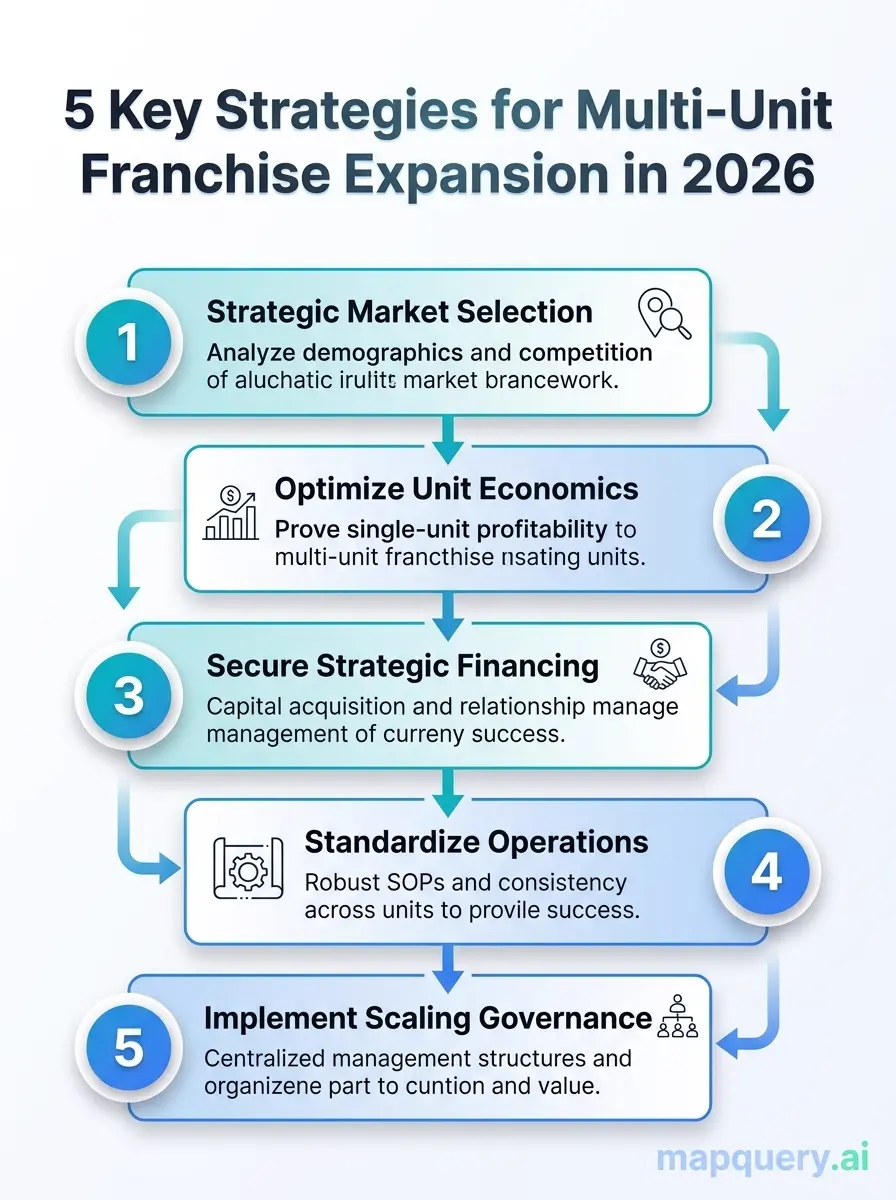
A concise visual guide outlining five essential strategies for expanding a multi-unit franchise in 2026. Learn actionable steps for growth and scalability.
Strategy 1: Data-Driven Site Selection
Data-driven site selection replaces gut instinct with a repeatable evaluation process. The core idea is straightforward: before signing a lease on any candidate site, you run the same structured analysis on each one so you are comparing locations on the same metrics, not on how they felt during a drive-by visit.
A rigorous site evaluation typically covers three categories of data:
- Competitor density and quality. Count how many direct competitors exist within a defined trade area (usually a one- to three-mile radius for QSR, wider for destination concepts), then look at their customer review ratings and recent sentiment trends. A market with five low-rated competitors and no clear leader is a fundamentally different opportunity than one with two dominant players averaging 4.5 stars.
- Demographic alignment. Match the surrounding population’s income, age distribution, household size, and lifestyle profile against your brand’s ideal customer profile. A location on a busy commuter corridor may look attractive on traffic counts alone, but if the median household income in the surrounding zip code falls below your brand’s threshold, the traffic does not convert. Franchise Creator’s research shows that 42% of franchises in “high-traffic” locations still underperform because of demographic mismatch.
- Foot traffic patterns and peak timing. Raw foot traffic volume is less useful than understanding when the traffic occurs and what the people passing by are doing. A lunch-heavy corridor is a good fit for a fast-casual concept but a poor fit for a sit-down dinner restaurant. Several location intelligence platforms now surface hourly and daily foot traffic estimates, which let you align your operating model to the actual flow of people rather than assuming even distribution.
The key is running the same evaluation across every candidate site in a consistent format. When your analysis is structured, you can compare sites side by side and make the case for one location over another with data your franchisor, lenders, and partners can verify. Tools like MapQuery.ai’s franchise site selection workflow are designed to support this process by letting you search for nearby businesses by type, review competitor data, run AI research on each location, and save everything to a project you can share.
Did You Know?
67% of franchise failures are attributed to poor location selection, often costing over $500,000 per unit.
-
International Franchise Association (IFA)

Strategy 2: Territory Mapping and Competitor Analysis
Territory mapping is the process of visualizing every direct competitor in a target market on a single map so you can identify saturation zones, underserved pockets, and the natural seams between trade areas. For multi-unit operators, this matters because every new unit you open changes the competitive geometry of the territory. A second unit placed too close to your first cannibalizes your own traffic. One placed too far leaves a gap a competitor can fill.
The most effective way to use territory mapping is to start with a three-layer analysis:
- Map every direct competitor in the target market. Plot them by location and attach their customer review data. You are not just counting competitors. You are assessing their quality. A market with five low-rated competitors and no dominant player is a fundamentally different opportunity than a market with two high-rated ones.
- Define realistic trade areas around each of your existing units. A trade area is not a perfect circle. It is shaped by drive-time barriers, highway exits, natural boundaries, and the actual customer draw patterns for your category. For a QSR concept, a two-mile radius might be the right scale. For a specialty fitness concept, customers may drive ten to fifteen minutes.
- Overlay coverage gaps. Where in the territory can a customer not reach one of your units (or a strong competitor) within the expected drive or walk time? Those gaps are your expansion candidates.
The clustered expansion model, opening two to three units within one metro area before moving to adjacent markets, works because it builds brand density in a single territory while keeping supply chain and management overhead concentrated. According to Apple Pie Capital’s franchise expansion research, sequential cluster rollouts also reduce the per-unit cost of local marketing because brand recognition compounds within the same trade area.
For ongoing territory management, competitor mapping tools let you re-check the landscape before each new unit decision. A location that was a clear gap twelve months ago may have been filled by a new entrant. Running a fresh competitor pull before each lease commitment is a low-cost safeguard against expanding into a market that has already shifted.
Strategy 3: AI-Powered Market Research
AI-powered market research changes the speed at which a development manager can evaluate a location. Instead of spending hours pulling data from individual review sites, census databases, and mapping platforms one at a time, you can ask targeted questions about a specific address and receive structured, sourced answers in minutes.
The practical value of AI research is not that it eliminates human judgment. It is that it front-loads the data gathering so you spend your time making decisions instead of collecting information. Here is what that looks like in practice:
- Competitor sentiment analysis. Instead of reading through hundreds of individual reviews, you can ask what customers consistently praise or complain about the top-rated competitors near a candidate site. The AI aggregates the patterns for you, which lets you spot operational gaps you could exploit or quality standards you need to match.
- Neighborhood trend signals. AI tools can surface recent development activity, new business openings, residential construction permits, and transit changes near a candidate site. These signals help you evaluate whether a neighborhood is improving, stable, or declining, which matters for a five- to ten-year lease commitment.
- Demographic and lifestyle context. Beyond raw census data, AI research can synthesize how a neighborhood’s population actually behaves: dining-out frequency, brand preferences, spending patterns, and commute routes. This context helps you assess whether your concept fits the market, not just whether the income numbers look right.
According to Franchise Creator’s 2026 market research, 70% of franchise systems have already adopted AI technology for market selection and territory planning. For multi-unit operators evaluating several candidate sites in parallel, AI-powered research is no longer a competitive edge. It is a baseline expectation.
Strategy 4: Customer Sentiment Monitoring Across All Units
Multi-unit operators face a specific challenge that single-unit owners do not: a weak performance at one location affects the reputation of all of them, especially if the brand name is shared. One unit with consistently poor reviews can suppress foot traffic at a nearby unit in the same territory.
Customer sentiment monitoring means tracking what reviewers actually say about each of your locations over time, not just the star rating. A unit can maintain a 4.2 average while its most recent thirty reviews trend downward, which signals an emerging operational problem that the lagging aggregate score has not yet reflected. Catching that pattern early is the difference between a quick operational fix and a six-month reputation recovery.
Here is what to track and why:
- Review volume and recency. A location that was getting fifteen to twenty new reviews per month and is now getting five may have a traffic problem, not a service problem. Declining review volume can signal that fewer customers are visiting, which is worth investigating before the revenue impact shows up in your P&L.
- Topic-level sentiment. Star ratings tell you whether customers are satisfied. The text of the reviews tells you why. Look for recurring themes across recent reviews at each unit: wait times, cleanliness, staff friendliness, specific menu items, parking. When the same complaint appears across multiple reviews within a short window, it points to a systemic issue at that location, not a one-off experience.
- Competitive positioning. Your units do not exist in a vacuum. If a nearby competitor’s sentiment improves sharply (new management, renovation, menu refresh), your unit’s relative position weakens even if your own reviews stay flat. Monitoring competitor sentiment alongside your own gives you early warning of competitive threats.
- Cross-unit pattern detection. If the same complaint starts appearing at multiple units simultaneously, it may indicate a brand-wide issue (a supply chain change, a new training gap, a policy change) rather than isolated location problems. Spotting that pattern requires looking at sentiment data across all units in a single view, not reviewing each location in isolation.
The goal of sentiment monitoring is not to react to every negative review. It is to identify trends early enough that you can address operational issues before they compound into a reputation problem that affects multiple locations.
Did You Know?
42% of franchises located in “high-traffic” areas still struggle with profitability if they lack specific demographic alignment.
-
Franchise Creator

Strategy 5: Capital Sequencing and Financing Structure
The best multi-unit franchise expansion strategies for 2026 treat financing as a sequencing problem, not a volume problem. The question is not “how much capital can I raise?” It is “at what point in each unit’s ramp-up cycle does the next draw need to hit?”
Capital sequencing means structuring your financing around the natural ramp-up curve of each unit rather than taking on all the debt at the start. A typical new franchise unit takes twelve to eighteen months to reach stable cash flow. If you open three units simultaneously and all three are in their ramp-up phase at the same time, you are carrying the full debt load with none of the units producing reliable revenue to service it. The math gets uncomfortable fast.
A more resilient approach looks like this:
- Open unit one and let it stabilize. Use the first unit’s operating data to validate your projections. Real revenue, real cost structure, real ramp-up timeline. This data becomes the foundation for your financing case for unit two.
- Use unit one’s performance to finance unit two. Lenders and franchisors are more confident when they can see a functioning location’s financials rather than a pro forma built on assumptions. Your borrowing terms improve because the risk profile is lower.
- Repeat the cycle. Each subsequent unit is financed with the benefit of actual operating history from the prior locations. By the time you are opening unit four or five, you have a track record that reduces your cost of capital and shortens your lender due diligence process.
Development managers who pair a strong capital sequencing plan with data-validated site selection have a measurably easier time securing lender confidence. A site evaluation report that shows competitor density, demographic alignment, and sourced market context is a stronger supporting document than a broker’s memo. It tells the lender that you have done the work to de-risk the specific location, not just the concept.
Explore Real-World Use Cases
The QSR Operator Evaluating a New Metro
A quick-service restaurant franchisee with four existing units in one city is evaluating expansion into a neighboring metro. She creates a MapQuery project for each of the three candidate neighborhoods, searches for her brand’s competitors within each map view, and runs AI research asking specific questions about peak hours, most-mentioned menu complaints, and demographic income brackets.
Within two hours, she has a side-by-side comparison of all three sites saved in her account, complete with source links she can share with her franchisor’s development team. One neighborhood that looked strong on paper has three high-rated competitors and a trending-negative review pattern. She eliminates it before spending a dollar on a feasibility study.
The Franchise Development Manager Running Parallel Territory Reviews
A franchise development manager for a fitness concept is evaluating 12 candidate sites across four markets simultaneously. Using MapQuery’s Pro plan, he creates a project per territory and loads up to 500 locations per project. He uses the
Save Your Research and Saved AI Results features
to keep every query organized without re-running the same searches.
When the regional VP asks for a shortlist of six sites, he pulls up saved projects and shares the interactive map links directly. No slide deck. No data re-entry. The AI results are saved with their original sources, so the VP can verify the underlying data independently.
The Multi-Unit Operator Monitoring Brand Health
An operator running seven units of a food and beverage franchise uses Customer Pulse monthly to monitor review sentiment at each location. One unit in a suburban market shows a consistent drop in service-related comments over three months. She catches the pattern before it surfaces in the franchisor’s quarterly audit and addresses the operational issue before it affects the neighboring unit’s traffic.
Final Thoughts
The best multi-unit franchise expansion strategies for 2026 are not complicated. They are disciplined. Every strategy on this list shares one foundation: evaluate locations with live, structured data before committing capital, not after.
The numbers back this up. Poor site selection remains the leading cause of franchise failure, and demographic mismatch alone accounts for nearly half of all underperforming “high-traffic” locations. These are not abstract risks. They are specific, measurable outcomes of expanding without a data-backed process.
MapQuery.ai is built to remove those risks from the equation. Whether you are a single franchisee planning your second unit or a development manager running parallel evaluations across a dozen territories, the platform gives you real answers about any location in minutes. Start with the free tier at mapquery.ai, or move straight to Pro if you are working at scale. Either way, you are making the next expansion decision with a clear picture of the market, not a guess.

Stop Guessing. Start Knowing.
Run your first franchise site evaluation in under five minutes. No credit card required.
Frequently Asked Questions
What is the best multi-unit franchise expansion strategy for 2026?
The best multi-unit franchise expansion strategy for 2026 combines data-driven site selection with AI-powered competitor analysis and territory mapping. Operators who validate each candidate site against real demographic and foot traffic data before signing a lease consistently outperform those who rely on intuition or broker recommendations alone.
How many franchise units should I open at once when expanding?
Most multi-unit franchise development managers recommend a sequential cluster model: opening two to three units within a defined territory before moving to adjacent markets. This approach builds operational density, reduces supply chain costs, and lets you validate a market before full capital commitment.
What tools do multi-unit franchise operators use for site selection in 2026?
In 2026, the most effective multi-unit franchise operators use AI-powered location intelligence platforms like MapQuery.ai to run competitor density analysis, pull live customer sentiment data, and compare candidate sites side by side. These tools replace spreadsheet guesswork with structured, sourced answers pulled directly from platforms like Yelp, Google Maps, and TripAdvisor.
Is high foot traffic enough to guarantee franchise profitability?
No. According to Franchise Creator, 42% of franchises located in high-traffic areas still struggle with profitability if they lack specific demographic alignment. The quality and intent of foot traffic matters as much as the volume, which is why demographic benchmarking is a non-negotiable step in any serious multi-unit expansion plan.
How does AI help with multi-unit franchise territory planning?
AI tools analyze competitor density, customer review sentiment, and neighborhood growth signals simultaneously, returning structured answers that a development manager can act on in minutes. Platforms like MapQuery.ai let you ask plain-English questions about any location and receive sourced intelligence without manual data synthesis.
What is the biggest risk when expanding a multi-unit franchise?
Poor location selection is the single largest risk. The International Franchise Association attributes 67% of franchise failures to location decisions, with average losses exceeding $500,000 per unit. Validating every site with live market data before signing a lease is the most effective way to reduce that risk in your multi-unit franchise expansion strategy.
Can I research multiple franchise sites simultaneously using MapQuery?
Yes. MapQuery.ai’s Pro plan supports up to 500 locations per project and unlimited projects, which makes it practical to run parallel site evaluations across an entire territory. Each project saves your AI research results, map pins, and source links so you can compare sites or share findings with partners without re-running queries. See the full feature set at
mapquery.ai/features
.