
Answer Engine Optimization (AEO) for physical sites is no longer optional. It is the difference between being the answer a customer hears from their phone and being invisible. “Near me” voice queries have grown by 150% since 2020, according to BrightLocal, and the businesses capturing those moments are not the ones with the biggest budgets. They are the ones with cleaner data, smarter location signals, and a real understanding of what AI tools need to surface their business as the correct answer.
If you own a brick-and-mortar business and you have not yet treated AEO as a location decision, that is a costly gap worth closing right now.

What AEO Actually Means for a Physical Site
Most business owners assume a Google Business Profile and a website are enough to get found. That was true a few years ago. In 2026, it is not. AI tools and voice assistants have changed how people find local businesses, and the rules are different now. AEO means making sure that when someone asks their phone or a chatbot a local question, your business is the one it names.
The reason that matters is simple. AI tools do not return ten links and let the customer choose. They pick one answer and deliver it. That answer is built from your reviews, your map listings, your hours, and how consistent your business information is across every platform the AI pulls from. A business with clean data, recent reviews, and accurate listings wins that spot. A business with outdated hours, scattered information, and thin reviews loses it to a competitor who has done the work. The gap between those two outcomes is exactly what AEO is designed to close.
Get Your Business Data Right First
This applies to every physical business, but especially those with multiple locations, recent address or hours changes, or high-turnover categories like food, fitness, or healthcare where details shift often.
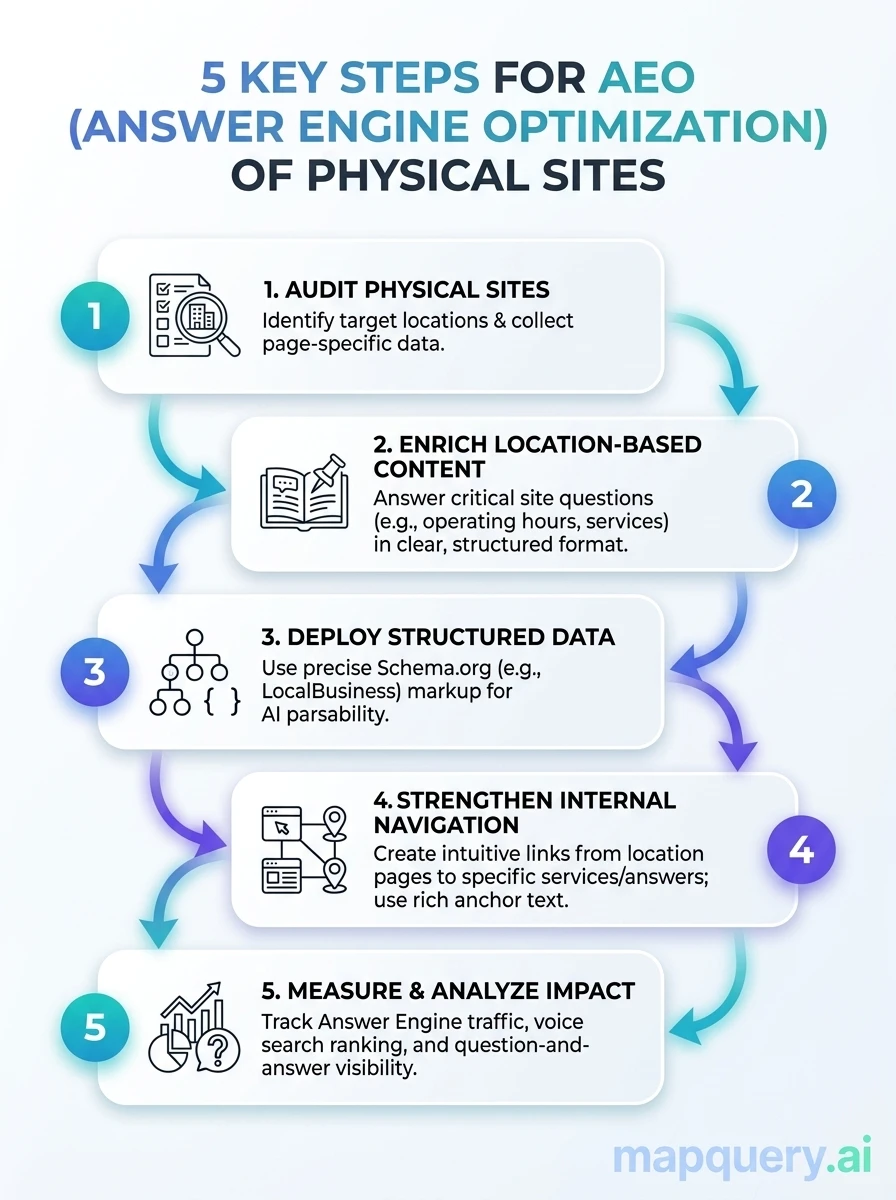
The starting point is making sure your business name, address, phone number, and hours are exactly the same on Google Maps, Yelp, TripAdvisor, and your own website. Then add business schema markup to your site so AI tools can read your details directly. Include your coordinates, service categories, and hours in that schema. Getting this right will stop you from losing ground, but it will not win you the top spot on its own. Think of it as the entry requirement. Your competitors are doing this too.
When your business information is inconsistent across platforms, AI tools lose confidence in your listing and move on to a competitor. Most business owners do not find this out until they notice a nearby competitor showing up in searches that should be theirs. A business a mile further away with cleaner data will beat you every time if your information is scattered or out of date.
Did You Know?
45% of consumers now use AI tools like ChatGPT for local business recommendations, up from just 6% the previous year.
—
BrightLocal Local Consumer Review Survey 2026

Answer the Questions Your Customers Are Already Asking
Most customers have questions before they visit. Restaurants, medical offices, gyms, and service businesses all deal with this. People ask things like “does this place take walk-ins?” or “are they open on Sundays?” before they ever leave the house. If your site has a clear answer to those questions, the AI reads it out. Without one, the AI looks for the answer in your reviews, where the information may be wrong, outdated, or written by someone who had a bad experience.
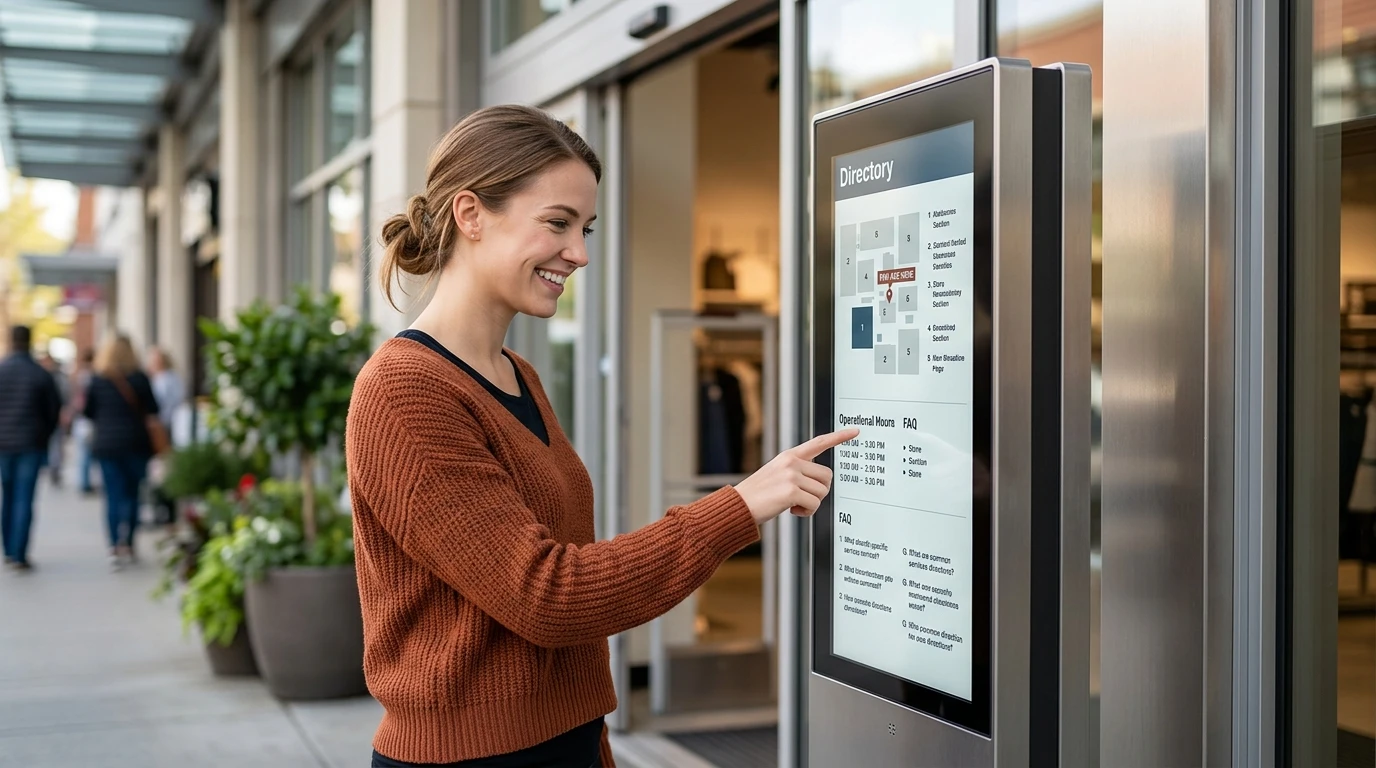
Voice and AI queries are plain-English questions by nature. A well-structured FAQ section on your location page gives AI tools a ready-made answer to quote. Keep it updated. Your hours, policies, and services will change over time, and your FAQ needs to change with them. Stale answers are worse than no answers, because AI tools will quote them confidently to customers who are about to show up expecting something different.
The fastest way to know which questions to answer is to look at what customers are already saying about businesses like yours. Check your reviews, check your competitors’ reviews, and write answers to what keeps coming up. If the three businesses nearest to you have no FAQ content and you build out a solid set of accurate answers, you are not just covering the basics. You have a real edge over every competitor who has not bothered.
Know Your Competitive Landscape Before You Build
When someone searches “best [category] near [neighborhood],” the AI answer they get is shaped by who is nearby, how many reviews those businesses have, and how strong their data signals are. If you do not know what that landscape looks like for your location, you are building an AEO strategy without knowing what you are up against.
This is especially important for anyone evaluating a new site, entering a new market, or advising on a property decision. A location that looks clear on a map may sit inside a dense cluster of well-reviewed competitors who already own the AI-generated answers for your category. Knowing that before you commit changes everything.
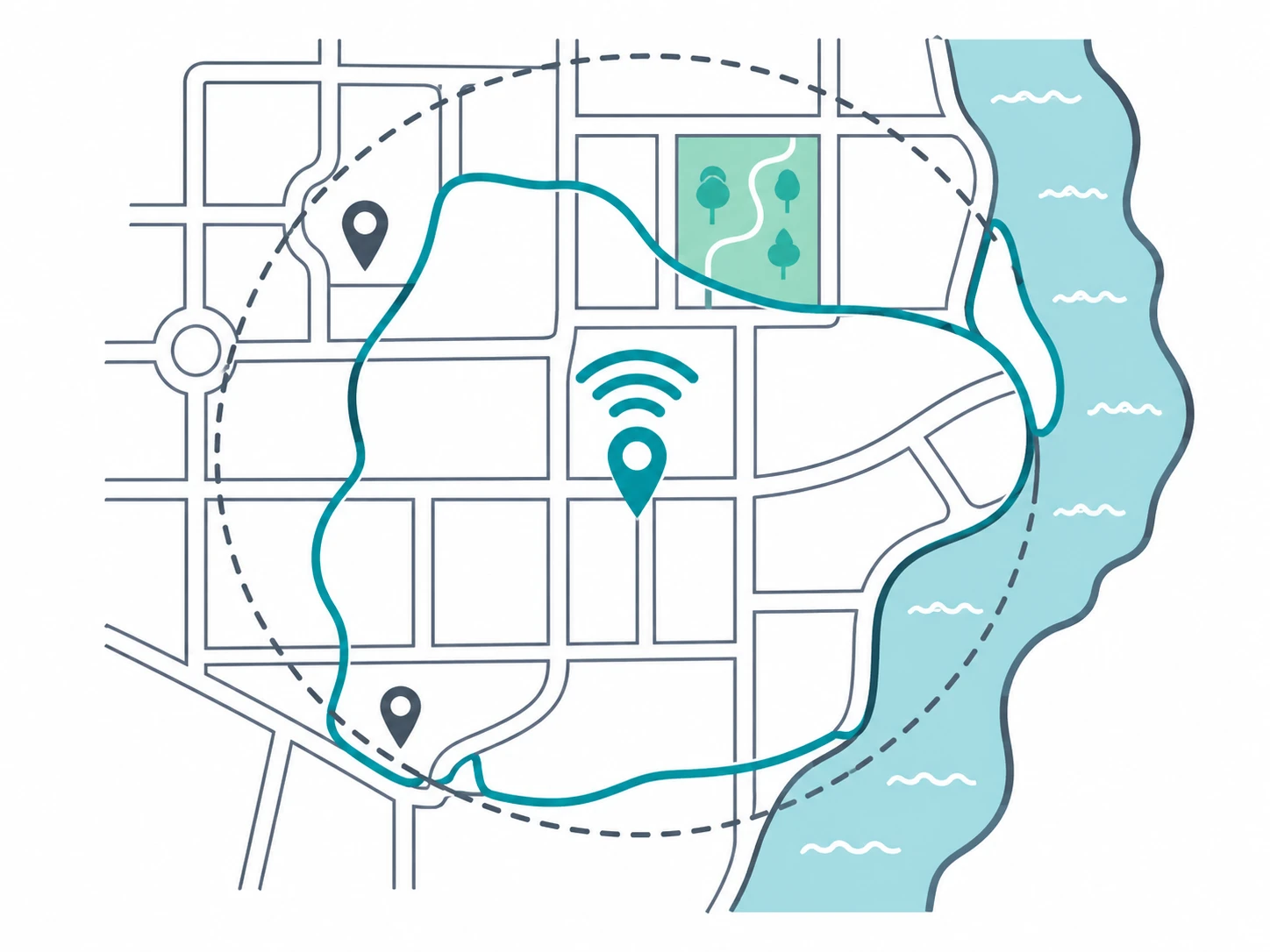
A 3-mile radius is a circle, not a trade area. Real trade areas follow roads, barriers, and how people actually move. The business that wins the AI answer is not always the closest one. It is the one with the strongest, most consistent signal set in that area. Before you invest in building your own AEO signals, you need to know who is already winning them.
Your Reviews Are an AEO Signal
AI tools read more than your hours and address. When someone asks “what is the best pizza place near me,” the AI is reading your review language from Yelp, Google Maps, and TripAdvisor to decide who to name. A business with lots of recent, detailed reviews gives it a confident answer. A business with 40 reviews from 18 months ago does not.
Volume matters, but recency matters more. A steady flow of recent reviews outweighs an old spike every time. Build it into how you operate, not just something you do once.
Mapquery’s Customer Pulse pulls live review signals for any location you research, so you can see what AI tools are seeing about your business and your competitors before it costs you customers.
Did You Know?
46% of voice search users now look for local business information on a daily basis.
—
SeoProfy 2026
Real-World Use Cases
AEO looks different depending on where you sit. A franchise operator, an independent retailer, and a commercial real estate broker all face the same underlying problem: AI tools are shaping which businesses get found and which do not. But the decisions each one needs to make are different. Here is how each scenario plays out in practice.
The Franchise Operator Entering a New Market
A franchise operator evaluating three candidate sites for a fast-casual restaurant uses Mapquery to run a natural language query: “fast casual restaurants within a half mile of each candidate address.” Pins appear instantly on the map with AI-backed summaries pulled from live review data.
She discovers that candidate site A sits inside a cluster of seven direct competitors, two of which have over 800 recent reviews and strong sentiment signals. Candidate site B has two nearby competitors with thin, aging review profiles. The AEO whitespace at site B is real, not assumed. She commits to site B and builds her location’s AEO strategy knowing she is not fighting uphill from day one.
The Independent Retailer Repositioning in a Competitive Neighborhood
A boutique fitness studio has been at the same address for four years. Foot traffic has declined. The owner runs a Customer Pulse query on her location and three nearby competitors. The data shows her review cadence has dropped: she had 40 reviews in the past six months, while a competitor who opened 18 months ago has 210 reviews in the same period.
The AEO signal gap is not her location. It is her review velocity. She builds an active review solicitation process, updates her FAQ content with the exact questions customers are asking, and adds FAQPage schema to her location page. Within 90 days, AI tools start surfacing her studio as the answer to “boutique fitness studio near [neighborhood]” queries that previously returned her competitor.
The Commercial Real Estate Broker Advising a Retail Tenant
A commercial real estate broker is helping a specialty food retailer evaluate two available spaces in different neighborhoods. Using Mapquery’s Just Ask a Question feature, he pulls a structured, data-backed summary of the competitive and sentiment landscape for both trade areas in under five minutes, with no query-building or technical background required.
The summary shows neighborhood A has a dense cluster of specialty food competitors with strong AI visibility signals. Neighborhood B has lighter competition and a visible gap in AI-surfaced answers for the client’s category. The broker uses this as part of his site recommendation, not as the only factor, but as a data point that directly affects the client’s long-term AEO position.
AEO Implementation Checklist for Physical Sites
Use this as your pre-launch or quarterly audit. Every item maps to a signal AI tools use when deciding which business to surface.
1
Audit NAP consistency
Check your business name, address, and phone number across Google Maps, Yelp, TripAdvisor, Apple Maps, and your own site. Every mismatch is a confidence penalty.
2
Implement business schema markup
Include geo-coordinates, hours, service categories, accepted payment types, and service area. Use FAQPage schema for your FAQ content.
3
Build a FAQ section for your location
Answer the plain-English questions your category generates: hours, parking, reservations, services offered, pricing ranges. Write answers as complete standalone sentences.
4
Establish a review velocity process
AI systems weight recency. A consistent cadence of recent reviews outperforms a historical spike. Build review solicitation into your post-visit or post-transaction workflow.
5
Research your competitive landscape
Before investing in AEO signals, understand the competitor density and review strength in your trade area.
Mapquery’s location intelligence blog
and the platform itself give you that picture from live data.
6
Monitor your signals regularly
Do not wait for a quarterly review. Set up regular checks on what AI tools are seeing about your location and your nearest competitors. Use those signals to update your content, schema, and review strategy.
7
Differentiate your category signal
If you are in a dense competitor cluster, you cannot win on proximity alone. Identify the attribute where your location stands out and build your AEO content strategy around making that as clear as possible to AI systems.
For more on how Mapquery supports these workflows, the Mapquery FAQ covers credits, data sources, and use cases.
The Businesses That Win Are Already Doing This
AEO for physical sites is not something to plan for next quarter. The businesses winning AI-generated local answers right now are not the ones with the biggest budgets. They are the ones with accurate data, recent reviews, and a clear picture of the competitive landscape around their location.
The gap between those businesses and the ones losing foot traffic to them is not talent or money. It is information. Most location and visibility decisions are still made without it. Understanding your trade area, your competitor signals, and what AI tools are already saying about your category is the work that closes that gap.
If you are thinking about related topics, local SEO and trust engineering, site selection strategy, and competitor analysis for location-based businesses all connect directly to what this post covers. The data you need to make these decisions exists. The question is whether you are using it.
Frequently Asked Questions
What is Answer Engine Optimization (AEO) for physical sites?
Answer Engine Optimization (AEO) for physical sites is the practice of structuring your business data, content, and location signals so that AI-powered tools and voice assistants return your business as the direct answer when nearby customers ask local questions. Unlike traditional visibility strategies, AEO targets AI summaries, not blue links, making it especially valuable for brick-and-mortar businesses that depend on in-person visits.
Is AEO worth it for small local businesses in 2026?
Yes. In 2026, 45% of consumers now use AI tools like ChatGPT for local business recommendations, up from just 6% the previous year, according to
BrightLocal
. If your physical site is not structured to appear in those AI-generated answers, you are ceding daily foot traffic to competitors who are.
How does customer sentiment affect AEO for a physical location?
AI answer engines pull from live review data on platforms like Google Maps, Yelp, and TripAdvisor to build the summaries they surface to users. Positive, detailed reviews signal that your location is the authoritative answer to a local question. Monitoring and responding to that sentiment in real time is a direct AEO input, not just a reputation task.
What data sources do AI tools use when answering local business questions?
AI tools and voice assistants draw from a mix of structured business data, review platforms like Yelp, Google Maps, and TripAdvisor, social signals from sources like Instagram, and on-page structured data such as schema markup. Keeping your data consistent and current across all of these sources is the foundation of AEO for physical sites.
How can I use location intelligence tools to improve AEO for my physical
site?
Tools like Mapquery.ai let you pull live web-sourced data signals from platforms like Yelp, Google Maps, TripAdvisor, and Instagram for any geographic area. You can use that data to understand competitor density, customer sentiment patterns, and local market gaps, all of which inform the AEO decisions that determine whether your physical site becomes the AI-surfaced answer for local queries.
What is the difference between AEO for a physical site and for an
online-only business?
AEO for physical sites places much heavier weight on geographic proximity signals, real-time review data, map listing accuracy, and voice query patterns tied to “near me” intent. Online-only businesses optimize for topical authority and structured content, while physical site AEO requires consistent NAP data, location schema, and live sentiment monitoring across local data sources.
How often should I update my location data to stay competitive with AEO?
Location data should be treated as a live asset, not a one-time setup. Hours, categories, services, and review responses should be reviewed at minimum monthly, and ideally monitored in real time. AI answer engines weight recency, and outdated data is one of the fastest ways to fall out of the AI-generated local answer set.

See How Your Location Looks to AI Tools
Mapquery.ai pulls live data from Yelp, Google Maps, TripAdvisor, and Instagram for any location you want to research.